Before Enabling Codex's 1M Context for GPT-5.6 Sol: Official Settings vs. an Observed Cap
Decision as of August 23
Audience: Developers using Codex on very large repositories or long-running sessions
| Workload | Current choice |
|---|---|
| Routine fixes, reviews, and research | Keep the default |
| Large-repository work that loses required detail after compaction | Test the override for one session |
| A literal 1M effective window is mandatory | Wait until the effective cap is confirmed |
| Usage must be tightly controlled | Keep the default |
Use the 1M override only when a specific workload must retain code or history that compaction removes. The configuration is simple, but GPT-5.6 Sol's model specification and Codex's effective client limit are not the same. Even the official override can be capped by the model catalog or account configuration delivered to a client.15
Start with a limited test
Keep the default for routine work and compare the one-off override only when compaction drops required information. Move it into the persistent configuration only after confirming both the effective cap and usage.
Test the 1M override in a new session
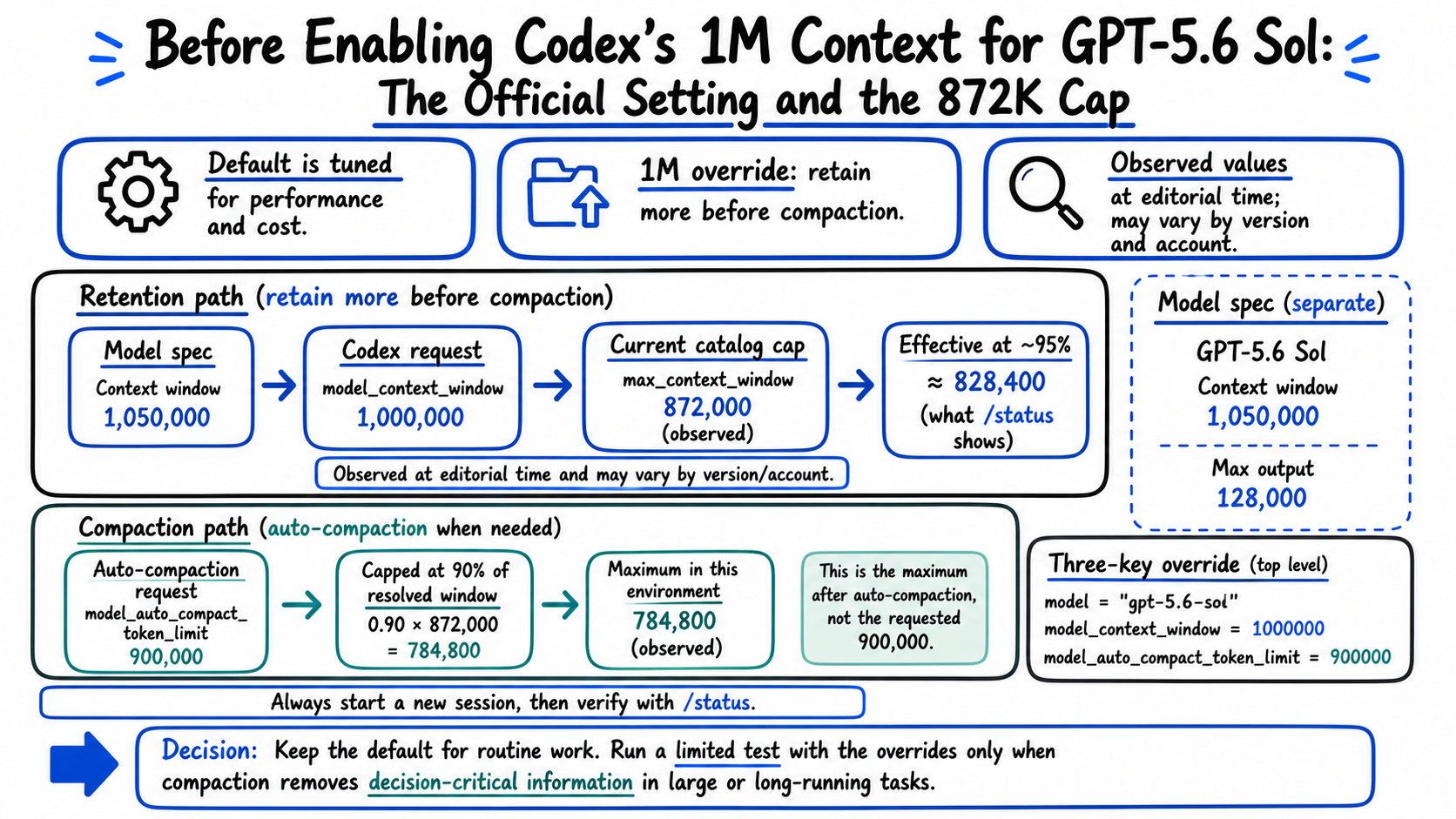
The configuration shared by OpenAI Codex lead Tibo Sottiaux places three keys at the top level of ~/.codex/config.toml.1
model = "gpt-5.6-sol"
model_context_window = 1000000
model_auto_compact_token_limit = 900000
model_context_window requests a context budget from Codex. model_auto_compact_token_limit requests the point at which Codex summarizes older history. Codex caps that request at 90% of the resolved context window, so the 872,000 cap observed in the editorial environment limits compaction to 784,800 or lower.46 After saving the file, restart Codex and open a new session.
For a one-off CLI test that leaves the default file unchanged, use:
codex -m gpt-5.6-sol \
  -c model_context_window=1000000 \
  -c model_auto_compact_token_limit=900000
This is the one-session syntax included in the official guidance.1
Both keys exist in the public Codex source.3 Acceptance of the keys does not guarantee that the requested values become the effective limits.
The model's 1.05M limit differs from Codex's effective cap
The GPT-5.6 Sol API model page lists a 1,050,000-token context window and a 128,000-token maximum output.2 That is a model specification. Codex separately distributes context metadata to its clients and plans.
Codex clamps model_context_window to the model catalog's max_context_window. It then applies effective_context_window_percent to reserve room for inputs, tools, and output.4Treat the configured value and the effective cap as separate numbers.
On August 23, a sanitized check of Codex CLI 0.149.0 on WSL and the server-delivered catalogs on Windows and WSL found a Sol default of 272,000, a configurable maximum of 872,000, and an effective percentage of 95%. Under that catalog, requesting 1,000,000 produces an effective display of about 828,400. Open issues in the official Codex repository also report client and account differences.56
Check /status after the first response in the new session, not only at startup. The bundled metadata showed a 1,000,000 maximum, while the server-delivered Windows and WSL values were 872,000, which is why the post-response check matters.6
The default protects routine performance and usage
Sottiaux's instructions say Codex's default limit is tuned to balance performance and cost.1 The override is therefore an opt-in for retaining more history before compaction, not a correction to a universally wrong default.
A larger window does not guarantee better results. It can increase the amount of history the model must search and the uncached input carried across turns. For small and medium tasks where compaction preserves the needed facts, the extra retained material adds little decision value.
The GPT-5.6 Sol API promotional price is currently $4 per million input tokens and $20 per million output tokens, available at least through November 21, 2026. For API pricing, requests above 272K input tokens price the full request at twice the input rate and 1.5 times the output rate.2 That 272K API pricing threshold is separate from the observed 272,000 default Codex context described above. Codex under a ChatGPT plan does not map directly to API billing, and OpenAI does not publish a fixed multiplier for how much faster this override depletes a weekly allowance. Judge adoption from before-and-after usage on the affected account rather than converting API prices into a weekly-meter estimate.
Workloads benefit only when they must retain more information
The useful dividing line is not repository file count. It is the amount of information that must remain available at the same time for the decision to stay correct.
| Workload | Why test the override | When the default remains better |
|---|---|---|
| Large migration | Retain many dependencies and changes together | The migration can be divided by boundary |
| Archaeological debugging | Retain long logs, older code, and competing hypotheses | The reproduction and diff are small |
| Cross-repository analysis | Compare distant modules without repeated reloads | Search and summaries can narrow the scope |
| Routine fixes and reviews | Little benefit from extra retention | Required facts survive compaction |
"Bigger feels safer" is not a sufficient reason. If no missing information can be named, splitting the task and rereading the relevant files makes usage easier to control.
A controlled comparison closes the evidence gap
Public evidence does not establish a performance-loss percentage, a ChatGPT-plan usage multiplier, or one effective cap across every Codex build and account. The editorial check inspected model metadata and the configuration path; it was not a performance benchmark on a giant repository.
Run the adoption test with one changing variable:
- The user records the Codex version, model, reasoning setting, and starting usage
- The user starts a new CLI session with the one-off override
- Codex returns the first response, after which the user checks the effective limit in
/status - The user compares a similar default session for missing post-compaction information and usage change
- The user leaves the override temporary if the cap shrinks or the setting disappears
Some workloads can justify the larger window. The adoption gate is not whether Codex accepts three lines; it is whether the effective limit persists, missing post-compaction detail decreases, and the additional usage is acceptable.
Related Articles
- Why Codex weekly usage may rise less than expected
- Separating causes of unexpectedly fast Codex weekly-limit depletion
- Comparing context compaction in Claude Code and Codex
Sources
Tibo Sottiaux, How to enable a 1M context in Codex, checked August 23, 2026. The post provides the settings, one-session CLI syntax, new-session instruction, and performance-and-cost warning. ↩↩↩↩
OpenAI, GPT-5.6 Sol Model, checked August 23, 2026. It supports the model limit, output limit, promotional price, and long-input pricing rule. ↩↩
OpenAI, Codex
ConfigToml, checked August 23, 2026. It definesmodel_context_windowandmodel_auto_compact_token_limit. ↩OpenAI, Codex model metadata, checked August 23, 2026. It describes the override ceiling and effective-window percentage. ↩↩
OpenAI Codex issues #38917 and #39144, checked August 23, 2026. These are user reports about catalog inconsistency, not proof of every account's state. ↩↩
Sanitized SmartScope editorial check, August 23, 2026. Codex CLI 0.149.0 and the Windows/WSL caches reported
context_window=272000,max_context_window=872000, andeffective_context_window_percent=95for Sol. No performance or usage benchmark was performed. ↩↩↩