Qwen3.8-27B Ranks Ninth in Code Arena WebDev, but Agent Reliability Is a Separate Test
Adoption decision as of August 26
Audience: Developers comparing open-weight models for local coding
| Workload | Current decision |
|---|---|
| Web interface generation and comparison | Add it to the shortlist |
| Short, supervised coding assistance | Test it on representative work |
| Long-running autonomous agents | Do not make it the default yet |
| Code that cannot leave local hardware | Test after sizing quantization and memory |
Test the model for local web generation and supervised coding; wait for repeated task-level results before promoting it to unattended, long-running work. Its ninth-place Code Arena WebDev result reflects human preferences on web-generation tasks that include multi-step reasoning and tool use, but it does not establish repository-scale completion rate or elapsed time.15
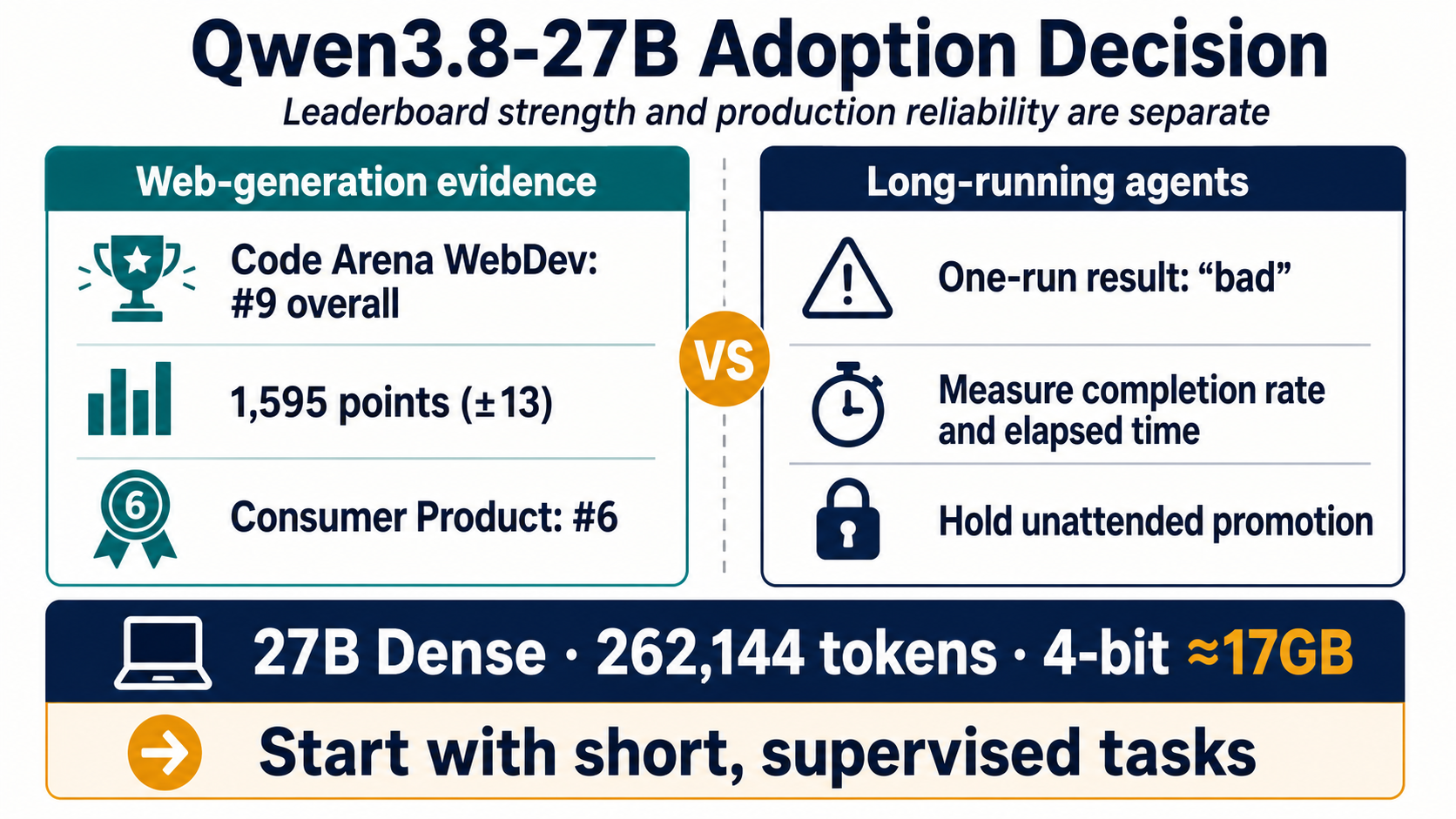
Ninth place makes it a credible web-generation candidate
Qwen3.8-27B ranked ninth overall with 1,595 points on the August 21, 2026 Code Arena WebDev leaderboard, but its rank range was 8–13 and its score interval was ±13, placing it in the leading group rather than at a permanent ninth-place point estimate.1
The domain boards placed it sixth for Consumer Product, seventh for Brand & Marketing, and eighth for Gaming, but the respective rank ranges were 2–15, 3–12, and 6–13, making them exploration signals under paired preferences rather than stable proof of category leadership.2
Arena preference does not measure autonomous completion
Code Arena WebDev uses human preference voting on front-end development tasks. The tasks include multi-step reasoning and tool use, but the leaderboard does not directly measure repository exploration, test repair, recovery from mistakes, or total task time.1
A public one-run experiment illustrates the boundary. For a roughly 600,000-token C-to-single-HTML port, Claude Code with Opus 5 produced the only result the author rated "okay" in 21 minutes. Qwen3.8-27B took 4 hours 18 minutes through hermes and 1 hour 40 minutes through codehamr; the author rated both results "bad." The Qwen runs used an RTX 6000 Pro 96GB with vLLM, FP8 weights, an FP8 KV cache, and the full 262,144-token context.5
That experiment does not prove a general model ranking. The source exceeded the context window, there was one run per configuration, and a thin one-shot prompt mixed model, harness, and orchestration effects. Those 96GB FP8 timings cannot be transferred to the 4-bit 24GB-class GPU or 32GB Mac mini configurations discussed below. It does show why a high preference rank cannot be converted into a claim about fast, reliable autonomous completion.
Official benchmarks must retain their harness conditions
The Qwen model card reports 61.7 on SWE-bench Pro and 90.3 on LiveCodeBench v6, above the Opus 4.6 Max values shown in the same table. Opus remained ahead on Terminal-Bench 2.1 at 78.2 versus 73.0, GPQA Diamond at 91.3 versus 89.2, and Humanity's Last Exam at 40.0 versus 30.8.3
The comparison is not fully harmonized. For SWE-bench Pro, the Opus value is its officially reported result, while Qwen evaluated the other models with a Claude Code harness. Artificial Analysis provides a separate view for the 4B-40B small open-weight class. Its nine-evaluation Intelligence Index gives Qwen3.8-27B at xhigh a score of 52, but that score alone does not establish long-running agent reliability. The page also describes provider-measured output speed as below the comparable-class median and token generation as unusually verbose; that provider speed is not a local-hardware measurement.4
An adoption test therefore needs two columns: whether the model can solve the task, and how much elapsed time, retrying, and generation it takes to finish.
The ranking and benchmark tables are verifiable, but repeated independent agent tests and measurements on the new Mac mini are not yet available.
The dense 27B design fits local deployment more readily
Qwen3.8-27B is a 64-layer dense model combining 48 Gated DeltaNet layers with 16 Gated Attention layers. It supports a native 262,144-token context, image and video input, adjustable Thinking, and an Apache 2.0 license.3
The weights are roughly 54 GB in BF16 and 27 GB in FP8 by parameter-size calculation. Simon Willison reports that a practical 4-bit build fits in a roughly 17 GB file; weights alone therefore fit within a 24 GB-class GPU as a capacity estimate, but runtime headroom is still required.6
Fitting the file is not the same as serving a long context comfortably. The operating system, runtime, KV cache, MTP draft model, and concurrent work need additional memory. Qwen enables Thinking by default and sets reasoning_effort to xhigh, so simple workloads should also measure reasoning overhead.3 Qwen also warns that lowering reasoning effort may increase failures and retries, so total completion time in multi-turn agent work does not always fall.3
In Willison's environment, MTP speculative decoding was about 72% faster than the default LM Studio GGUF setup. That is a configuration-specific observation, not a universal speedup, but it demonstrates that runtime choices materially affect delivered performance.6
Mac mini selection starts with memory capacity
Apple's current store lists M6 configurations with 16 GB, 24 GB, and 32 GB of unified memory, with 32 GB the largest listed option, while the M5 Pro model supports up to 64 GB.78 Running a roughly 17 GB 4-bit build on M6 therefore requires the 32 GB configuration; it does not fit the 16 GB entry configuration, and 24 GB leaves little room for the operating system, runtime, and KV cache. For sustained FP8 use around 27 GB, the M5 Pro's 64 GB option is easier to plan around.
This is a capacity estimate, not a Mac mini performance test. There is no independent Qwen3.8-27B result on the unreleased systems yet. Pair this analysis with the Gadgets guide, The New Mac mini Starts at ¥149,800, and post-release inference measurements.9
Adoption depends on completed-task economics
Qwen3.8-27B is most compelling when code must remain local, fixed hardware cost is acceptable, and evaluation can start with short web-generation or supervised coding tasks. If unattended completion, tight deadlines, and low retry rates are requirements, do not switch the default based on the Arena rank alone.
Run the same representative task more than once and record four items:
- Completion criteria and tests fixed before execution
- Model, quantization, context, Thinking level, and harness
- Success rate, wall-clock time, retries, and GPU time
- The cloud-model difference and cost per completed task
The Code Arena result is a reason to test Qwen3.8-27B. The promotion gate is an acceptable completion rate and total elapsed time on the target repository.
Related Articles
Sources
Arena, Code Arena WebDev Overall Leaderboard (accessed August 26, 2026). The August 21 board supplies rank, score, rank spread, votes, and task framing. ↩↩↩
Arena, Consumer Product, Brand & Marketing, and Gaming (accessed August 26, 2026). ↩
Qwen, Qwen3.8-27B Model Card (accessed August 26, 2026). Architecture, context, license, Thinking controls, official benchmarks, and harness notes. ↩↩↩↩
Artificial Analysis, Qwen3.8 27B (xhigh) (accessed August 26, 2026). Intelligence Index v4.1.1, speed, output-token use, and comparison class. ↩
Reddit r/LocalLLaMA, New qwen3.8:27b on a 39k line C to single-file HTML / three.js port (accessed August 26, 2026). This is one author's one-run experiment, not a general benchmark. ↩↩
Simon Willison, Qwen 3.8 27B is excellent, but it defaults to wildly overthinking things (accessed August 26, 2026). Approximate 4-bit file size and a configuration-specific MTP comparison. ↩↩
Apple Japan, Buy Mac mini (accessed August 26, 2026). Current M6 configurations with 16 GB, 24 GB, and 32 GB unified memory. ↩
Apple Newsroom, Apple unveils a more powerful Mac mini featuring the all-new M6 and M5 Pro (August 26, 2026). M5 Pro support for up to 64 GB unified memory. ↩
SmartScope Gadgets, The New Mac mini Starts at ¥149,800 (August 26, 2026). Configuration comparison and the pre-release test boundary. ↩