Why Codex Weekly Usage Can Increase Less Than Expected: Caching Is Not the Whole Explanation
The boundary to check first
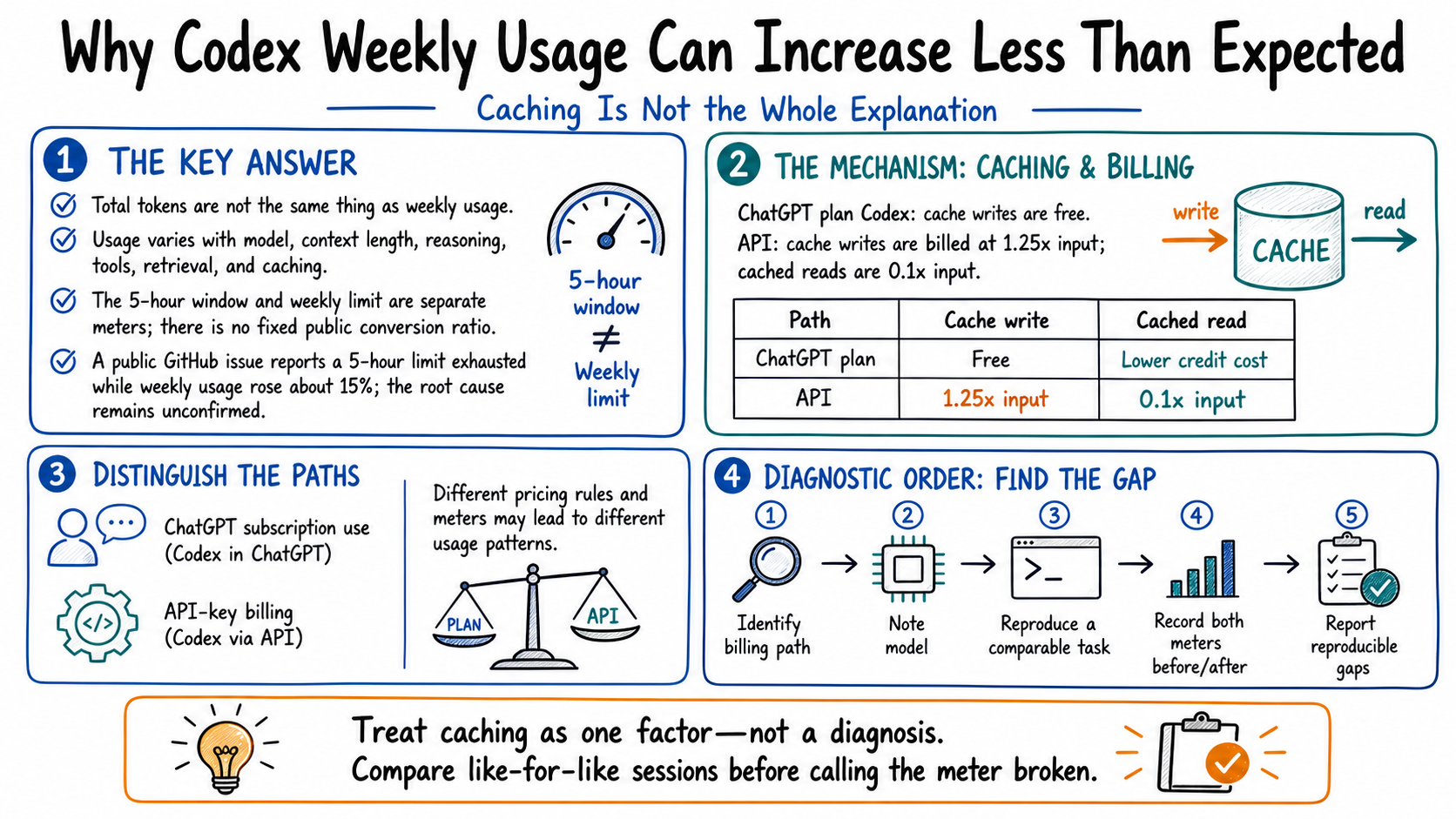
Caching affects Codex usage, but it cannot by itself establish why the weekly meter increased less than expected. OpenAI's current documentation says model, context, reasoning, tools, retrieval, and caching affect usage, while it does not publish a fixed conversion ratio between the five-hour and weekly limits.1
| What to inspect | What the official sources establish |
|---|---|
| Cached input | It uses fewer credits than uncached input |
| Model and task | Model, reasoning, tools, and retrieval change usage |
| Five-hour and weekly limits | No fixed relationship is published |
| A meter mismatch | Public information cannot distinguish cache effects from a defect |
Raw token totals do not determine Codex usage
OpenAI's Codex Pricing documentation says credits are calculated from rates for input tokens, cached input tokens, and output tokens.1 It also says similar-looking tasks can consume different amounts because model choice, context, reasoning, tool use, retrieval, and caching all affect usage.
The total token count shown in a log therefore does not have to move the usage meter proportionally. Two sessions with the same total can differ in cached-input share, output length, model, reasoning, and tool calls.
The documentation does not establish that the weekly percentage is a direct display of discounted credits. The internal formula for the weekly meter is not public, so the rate card and the percentage meter should not be treated as identical calculations.
ChatGPT plans and API keys use different billing paths
Codex under a ChatGPT plan must be distinguished from Codex using an API key. Plus, Pro, and Business use included limits and additional credits, while API-key usage is billed at standard API rates.1
This distinction also matters for cache writes. The ChatGPT-plan Codex rate card says cache writes do not consume credits.2 The OpenAI API pricing page separately lists GPT-5.6 cache writes at 1.25 times uncached input and cached reads at one tenth of uncached input.3
“Cache writes are free” therefore describes Codex under a ChatGPT plan and cannot be generalized to API-key billing. The first diagnostic step is to identify whether the session used a ChatGPT allowance or API-key billing.
No fixed ratio is published for five-hour and weekly limits
OpenAI says local messages and cloud chats on ChatGPT plans share a five-hour window and that additional weekly limits may apply.1 The later issue report uses 20 percent as the reporter's expectation, not as a conversion ratio published by OpenAI.4
A difference between the two meters cannot by itself prove a defect. The public documentation does not establish that both windows use the same workload mix, measurement period, or conversion formula.
Cached input is rated at one tenth of uncached input
As of August 22, 2026, the Codex credit-rate table on the Pricing page prices cached input for GPT-5.6 Sol, Terra, and Luna at one tenth of each model's uncached input credit rate.1 Reuse of content that the service treats as cached input can therefore produce a lower credit cost than the visible input-token total might suggest.
The total alone still does not reveal how much cache reuse occurred. Without the session's input, cached-input, and output breakdown, an observer cannot infer cache savings from a weekly increase that appeared smaller than expected.
Model choice changes consumption for the same category of work
GPT-5.6 Sol, Terra, and Luna differ in both intended workload and credit rate. OpenAI positions Sol for the hardest reasoning and coding, Terra for a balance of intelligence and cost, and Luna for fast, high-volume work.1
A comparison across models also needs similar task difficulty, context, reasoning settings, and tool use. Holding only the model name constant does not make a long-running agent task comparable with a small local edit.
Fast mode consumes credits at a higher rate for supported models. Image generation uses included limits about three to five times faster on average, depending on quality and size.1 Counting each interaction as one message hides those differences.
The 15 percent report remains an unresolved observation
An issue in OpenAI's Codex repository reports that a Pro 20x user exhausted a five-hour allowance while the weekly meter increased by only about 15 percent.4 As of August 22, 2026, the issue remains open with bug and rate-limits labels.
The issue is a user observation, and the public thread contains neither a maintainer conclusion that caching explains the result nor a diagnosis confirming a product defect. The reporter lists several possibilities, including over-counting in the short window, a different multiplier, duplicated requests or retries, or an entitlement mismatch.
The report therefore establishes only that a user observed a discrepancy. The same symptom cannot be diagnosed without the session's cache breakdown and server-side accounting.
Diagnose usage by holding conditions constant
Use the following sequence when investigating the meter.
- The user confirms whether the session used a ChatGPT plan or an API key.
- The user records the model, reasoning setting, Fast mode, image generation, and local or cloud execution.
- The user records the usage figures shown in the client and account before and after the task.
- The user reports a reproducible mismatch with the app version, plan, timestamps, and, when available, a session identifier or diagnostic information, without including secrets.
This process still cannot audit the weekly meter's internal formula from the client side. It can establish the published rate card, chosen execution conditions, before-and-after display, and reproducibility.
Caching can explain low consumption relative to a large token total, but it is not the only candidate. The sound conclusion is to separate caching, model choice, task characteristics, and window design, then treat a reproducible residual mismatch as a possible defect.
Related Articles
- Choosing Claude Code or Codex by work structure
- Choosing a Codex model for concentrated weekend work
- Comparing GitHub Copilot model costs with AI Credits
Sources
OpenAI, “Codex Pricing”, accessed August 22, 2026. It documents plans, five-hour and weekly limits, usage factors, token-based credit rates, and model positioning. ↩↩↩↩↩↩↩
OpenAI Help Center, “Codex rate card”, accessed August 22, 2026. It states that cache writes do not consume credits for Codex under ChatGPT plans. ↩
OpenAI API, “Pricing”, accessed August 22, 2026. It lists API rates for uncached input, cached input, cache writes, and output for GPT-5.6 models. ↩
openai/codex issue #32392, “[Pro 20x] 5-hour limit exhausted while weekly usage increased by only 15%”, accessed August 22, 2026. It provides the user report, open status, labels, and the scope of the public thread. ↩↩