Why Codex Weekly Usage Drains So Fast: Separating the June Incident from July Limit Changes
Assessment as of July 24
For: Developers on paid Codex plans who believe their weekly allowance is falling faster than before
| Claim and assessment | What primary sources establish |
|---|---|
| Silent weekly-allowance cut: unsupported | The Codex lead denied a nerf, and no reduced weekly value has been published |
| Unrequested work consumed usage: confirmed | OpenAI fixed excessive auto-review, subagent, and background-suggestion activity in June |
| Five-hour-window removal accelerated drain: structurally plausible | The short-term brake was temporarily removed on July 12 |
| The same incident persisted after July 22: unconfirmed | New reports exist, but no matching official postmortem was public by July 24 |
The reports of fast Codex weekly-usage drain have confirmed causes. The timeline circulating on social media, however, combines separate events. OpenAI's explanation of auto-review, subagent work, and background suggestions was published on June 29, not in late July.12
July brought a different sequence: the GPT-5.6 launch, temporary removal of the five-hour window, a product-context rollback, and adjustments to reasoning and multi-agent usage.345 The June fixes therefore cannot close the case on late-July reports, but those reports also do not prove a silent quota cut.
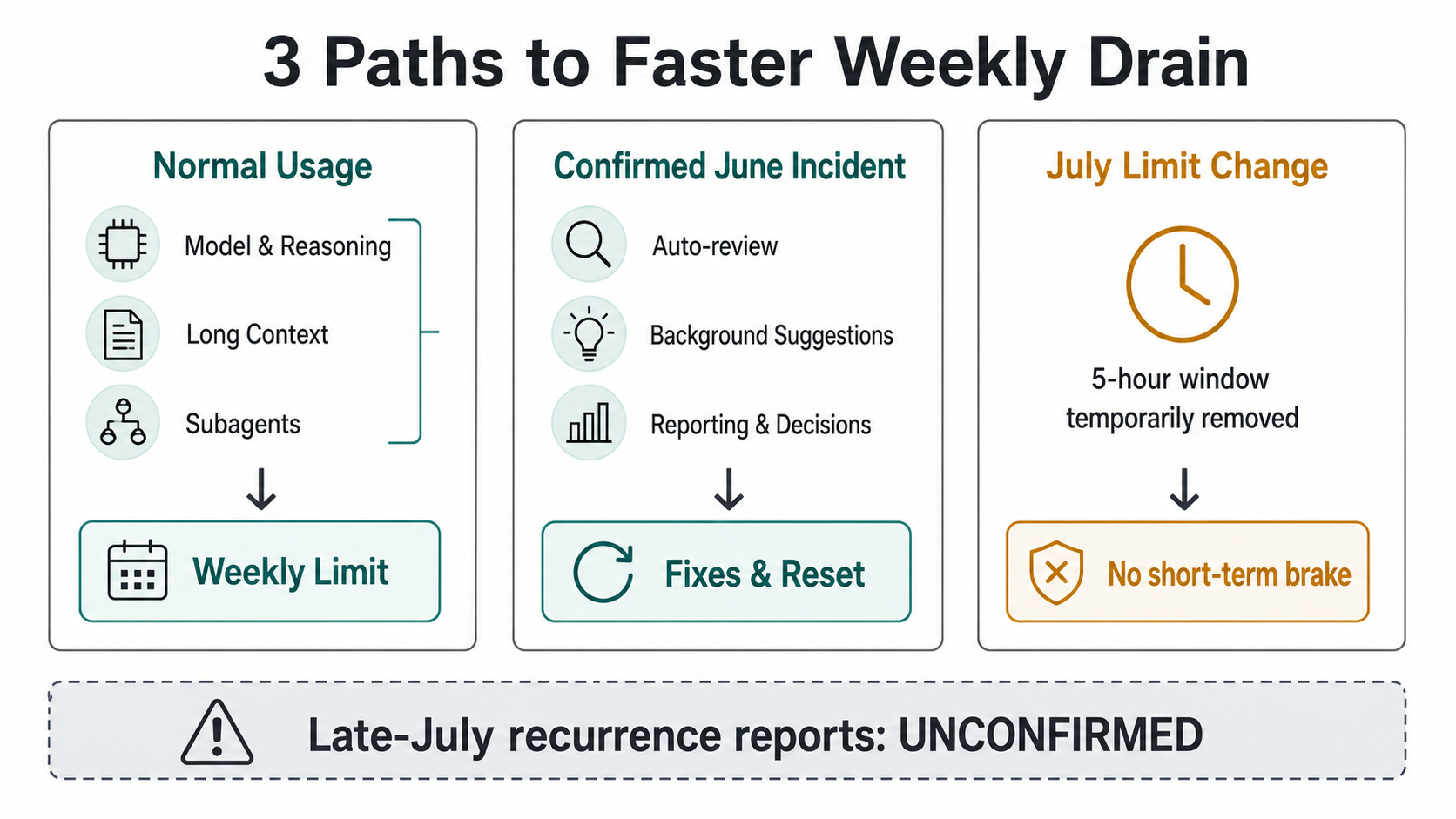
The June incident combined automatic work with misleading usage reporting
On June 26, OpenAI Status began investigating reports that Codex limits were being consumed faster than expected. Its June 29 resolution said some accounts had been incorrectly rate-limited by abuse and fraud-prevention systems and described the impact as limited.1
On the same day, Codex lead Tibo Sottiaux said there was no single central cause. Several smaller problems had compounded for some users.2
| Problem | What happened | OpenAI's response |
|---|---|---|
| Auto-review | It became more proactive than intended | Reverted the related change |
| Subagents | Another change triggered additional delegated work | Reduced the unintended work |
| Background suggestions | They could run twice or retry too often after failures | Fixed scheduling, duplication, and retries |
| Usage reporting | Auto-review appeared as GPT-5.4, while failed and rate-limited requests appeared in turn graphs | Added a separate category and counted only successful requests in graphs |
Actual consumption and displayed consumption were different problems. Auto-review and background suggestions added real background token use. Rate-limited requests were not charged, but the product displayed them incorrectly in usage graphs.
OpenAI shipped hotfixes across the CLI, desktop app, and usage backend. It reset limits, credited one additional banked reset, and added monitoring intended to detect background-usage regressions earlier.2
July changed consumption pace even without a published weekly quota cut
GPT-5.6 Sol entered general availability on July 9 and became available in Codex.3 On July 10, OpenAI announced two additional rate-limit resets within 24 hours to encourage testing of the new model.6 Neither announcement disclosed a smaller weekly allowance.
On July 12, OpenAI temporarily removed the five-hour restriction for Plus, Business, and Pro plans.4 This was not a quota reduction, but it changed pacing. The short window previously forced a pause before users could continue spending their weekly allowance. Without it, the same weekly budget can be consumed in a longer uninterrupted session.
On July 13, Sottiaux denied a nerf and described four adjustments.5
- OpenAI deployed inference optimizations expected to provide about 10% more GPT-5.6 Sol usage.
- Codex temporarily rolled its product context setting back from 372,000 to 272,000 tokens.
- OpenAI reverted experiments that changed internal reasoning-effort values.
- OpenAI began fixing slightly higher-than-intended multi-agent usage at high and xhigh reasoning effort.
The 372,000-to-272,000 rollback did not reduce the model's maximum context window. The GPT-5.6 Sol API model supports 1,050,000 tokens, but a request above 272,000 input tokens is priced at 2× input and 1.5× output for the entire request.7 OpenAI said the 372,000 product setting caused more usage to be charged than intended, so it restored the lower setting while it worked on a fix.5
The July changes therefore pushed in opposite directions. Inference optimization and the context rollback reduced expected drain. Removing the short-term window and running long-context, high-reasoning, multi-agent work made it easier to spend weekly capacity quickly.
The four popular explanations do not have equal evidentiary support
| Explanation | Assessment | How to read it |
|---|---|---|
| Silent nerf | Unconfirmed | OpenAI denied it, and no primary source publishes a lower weekly value |
| Metering or display defect | Partly confirmed | The June consumption and graph issues, plus July's 372,000 setting, were acknowledged |
| Five-hour-limit change | Confirmed | It affected pacing rather than the published weekly total |
| Heavier models and features | Confirmed | The official rate card varies usage by model and token type |
In April 2026, OpenAI moved Codex from average per-message estimates to credits aligned with API token usage.8 The current rate card lists GPT-5.6 Sol at 125 input, 12.5 cached-input, and 750 output credits per million tokens. Terra is half those rates, while Luna is one fifth.
Two tasks with one prompt each can therefore consume very different amounts. Model choice, output volume, conversation history, reasoning effort, and subagent count all matter. A comparison that holds only prompt count constant cannot establish a quota reduction.
The late-July recurrence reports remain unresolved
On July 22, users including Pro 20x subscribers again reported unusually fast weekly drain.9 Those reports are worth preserving as observations, but community posts alone cannot separate a plan-wide allowance change from a model-specific cost, a workflow effect, or an account-level defect.
OpenAI Status lists a GPT-5.6 Sol overload incident on July 17, a Codex access issue on July 18, and a GitHub-dependent workflow outage on July 20.10 None is an official postmortem for the July 22 weekly-drain reports. As of July 24, no new usage incident or investigation summary equivalent to the June 29 disclosure was public.
This is the crucial boundary. The June bugs were real, but their fixes cannot automatically explain or resolve the late-July reports. The public record establishes multiple earlier drain mechanisms and July pacing changes, not the cause of every current account report.
Shared pools and automatic work amplify differences between users
OpenAI's plan documentation says Codex, ChatGPT Work, ChatGPT for Excel, and Workspace Agents draw from the same agentic usage and credit pool where those features are available.11 Consumption varies with task complexity, model, execution location, codebase size, and session length.
The same plan can therefore behave very differently when a user:
- continues a long thread that repeatedly carries a large context;
- runs multiple subagents at high or xhigh reasoning effort;
- also uses other products backed by the shared pool;
- triggers frequent background suggestions or auto-review;
- generates long outputs or repeatedly returns large tool results.
Reports of never reaching the limit and reports of losing a large percentage in one day can coexist without contradiction. The allowance is not a uniform prompt counter.
A controlled one-task comparison turns a feeling into evidence
Record one task at a time under reproducible conditions.
- The user records starting usage in the dashboard or with
/status. - The user fixes the model, reasoning effort, thread age, repository, and subagent count.
- Codex performs one small, bounded task, and the user records usage immediately afterward.
- The user repeats a similar task in a new thread with lower reasoning and no subagents.
- If the difference reproduces, the user reports the timestamps, client version, session log, and dashboard evidence in an official issue.
OpenAI's own conservation guidance recommends smaller prompts, a shorter AGENTS.md, disabling unused MCP servers, and using a smaller model for routine work.12 These steps reduce ordinary consumption while making a controlled comparison easier.
For individual subscribers, the documented visibility surfaces are the usage dashboard and /status. OpenAI's public documentation did not expose a Plus or Pro API for exporting the per-task background-token breakdown and complete reset history as of July 24. Until that accounting becomes easier to inspect, similar disputes will remain likely.
Related Articles
- GPT-5.6 Sol, Terra, and Luna release
- How Claude Code and Codex compact context differently
- Safety settings for long-running Codex work
OpenAI Status, Codex Usage Limits Depleting Faster Than Expected, June 26–29, 2026. ↩↩
Tibo Sottiaux, Codex usage limits will be fully reset again, June 29, 2026. ↩↩↩
OpenAI, Model Release Notes: Introducing GPT-5.6 Sol, July 9, 2026. ↩↩
Tibo Sottiaux, Temporarily removing the 5 hour usage limit restriction, July 12, 2026. ↩↩
Tibo Sottiaux, Updates for Codex and ChatGPT Work users, July 13, 2026. ↩↩↩
Tibo Sottiaux, Resetting rate limits twice after the GPT-5.6 Sol launch, July 10, 2026. ↩
OpenAI, GPT-5.6 Sol Model, accessed July 2026. ↩
OpenAI, Codex rate card, accessed July 24, 2026. ↩
Reddit r/codex, Weekly limit drop, July 22, 2026. This is a user report, not an independently verified measurement. ↩
OpenAI, Using Codex with your ChatGPT plan, accessed July 24, 2026. ↩
OpenAI, Codex Pricing: What can I do to make my usage limits last longer?, accessed July 24, 2026. ↩