What Was ChatGPT's Chat / Work Split? Current Modes and the Year-End Integration Comment
The operating rule to keep
| Work shape | Current operating rule |
|---|---|
| A quick question or text revision | Use Chat and decide the next step after each answer |
| Multi-step research through a finished deliverable | Give Work the goal, materials, and approval points first |
| Development against a repository | Use Codex with defined scope, tests, and diff review |
The Chat, Work, and Codex split introduced on July 9, 2026 asked users to choose an execution style before starting.1A durable internal procedure should describe delegated work and human checkpoints, not tab names. OpenAI president Greg Brockman said in a late-July interview that he expected the separate Work tab to disappear into ChatGPT by year-end, but that is a roadmap comment rather than a committed retirement date.56
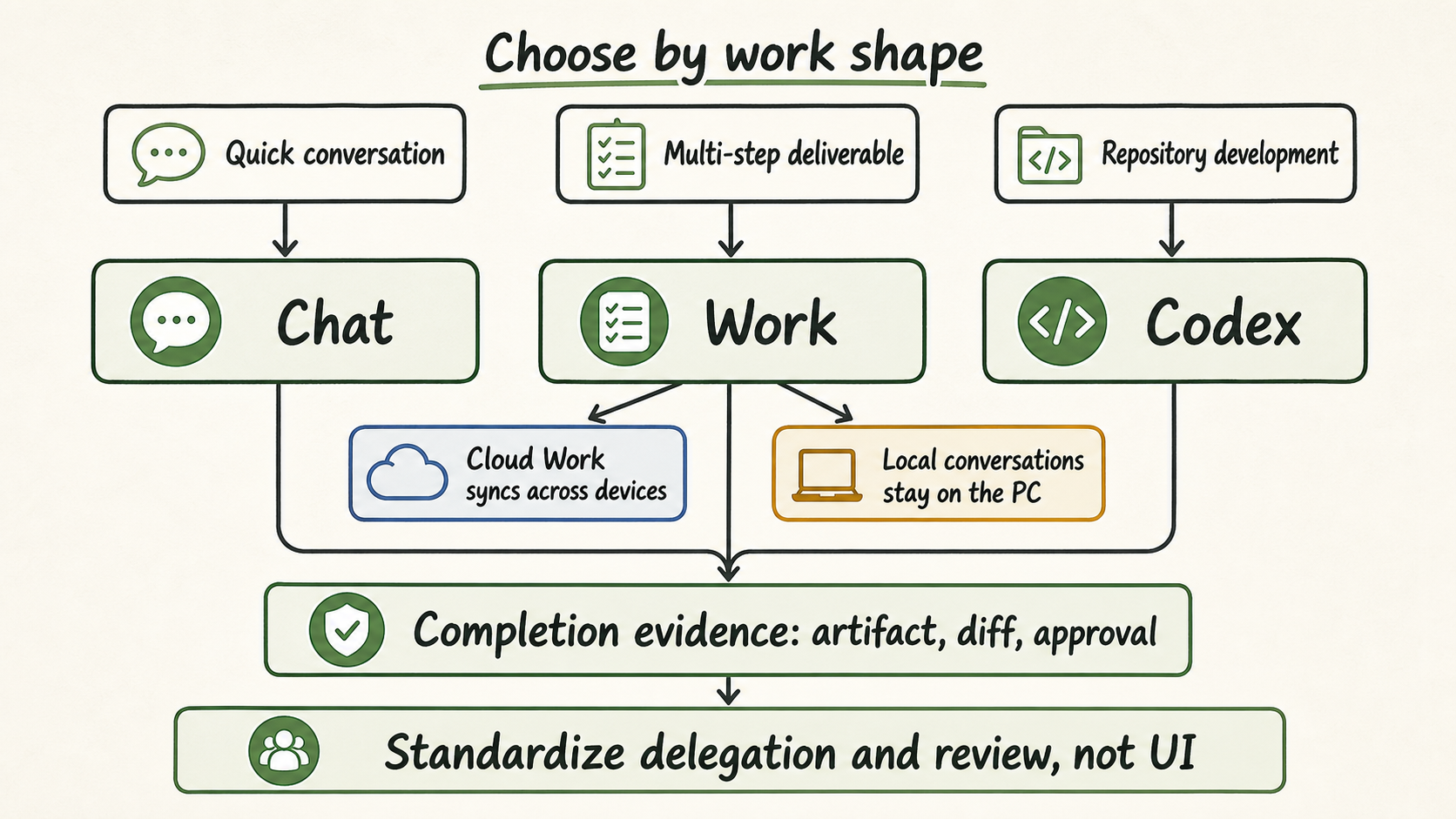
The completion condition determines the current entry point
Chat fits short exchanges in which the user reads an answer and decides the next question or revision. Work advances multi-step tasks to finished deliverables, while Codex handles code changes, tests, commands, and diff review.2 SmartScope routes by completion condition rather than output length: Work receives tasks whose artifact, sources, checks, and approvals can be declared up front, while exploratory dialogue stays in Chat.
Cloud and local execution expose different assets
Work on web and mobile runs in the cloud and cannot directly access files on the user's computer.2 It can use uploaded files and permitted connected services, but it is not a way to browse an arbitrary local folder. Tasks that need local files or desktop apps belong in desktop Work with narrowly granted access.
Codex remains a separate desktop view for local folders, repositories, terminals, and development tools.2 Its history remains separate from Chat and Work, so a development handoff should use repository diffs, test results, and pull requests as the system of record.
The same boundary controls sensitive information. Organizations need separate decisions for Work Cloud, Work Local, Codex Local, connected services, and browser access rather than one blanket permission for Work.2
Cloud Work conversations now sync across devices
At launch, reporting described cloud Work and desktop Work history as unsynchronized.4 OpenAI changed that boundary on July 16: cloud Work conversations can now continue across web, mobile, and desktop.1 Chat and Work also share desktop Recents, with filters and pinning by conversation type.
There is still an important exception: a local desktop conversation remains on that computer.2 An internal guide should distinguish cloud Work from local Work instead of saying that all Work history syncs.
Keeping deliverables, decisions, and approvals outside the conversation remains good practice. Synchronization helps resume work, but conversation history alone is not an organizational review record.
Standard Chat exposes reasoning levels rather than every model name
An updated GPT-5.6 Sol and a reasoning slider are rolling out to eligible paid ChatGPT plans.31 Plus offers Medium and High, while Pro, Business, and Enterprise add Extra High; Pro-specific options remain limited to eligible plans.3 Enterprise workspaces may temporarily retain the previous picker because of workspace settings or staged rollout.
Configure in the model picker controls automatic switching from an instant response to Medium reasoning. When reproducibility matters, turn automatic switching off and choose an available reasoning level directly.
GPT-5.6 Terra and Luna are not selectable in the standard Chat model picker. Depending on the plan, they remain available through Work, Codex, or the OpenAI API, so a procedure that requires a named model cannot assume ordinary Chat alone.3
The August 6 update changed Chat but not Work or Codex
On August 6, OpenAI announced the updated GPT-5.6 Sol and reasoning slider for Plus and Pro Chat.1 GPT-5.6 Luna was scheduled to become the Free and Go default that week, with unlimited text chat and a Think button beginning the following week. Abuse guardrails still apply, and file uploads, images, and other tools retain limits.
The release applies only to the Chat experience; Work and Codex were unchanged.1 The shared GPT-5.6 Sol label therefore does not establish identical behavior across the three product surfaces.
An organizational standard should record the surface, reasoning level, automatic switching, and usage pool alongside the model name. “Use Sol” does not capture enough of the execution condition.
The three-way split exposed latency and permission differences
Work launched as an agent that can use connected apps and files, perform research and analysis, and create finished documents, tables, presentations, reports, and Sites.1 Users can follow progress, answer questions, redirect the work, and approve important actions.
Short conversational help and longer autonomous execution have different latency, permission, usage, and checkpoint requirements. Three visible entry points were one way to make those differences explicit.
The cost was a choice before the user had begun the task, with Codex placed at a different navigation level from Chat and Work. OpenAI added a Chat / Work toggle, a global ChatGPT / Codex switcher, and unified Recents on July 16.1 That rapid revision is evidence that the launch information architecture did not hold unchanged.
The year-end integration remains a forecast without a fixed date
When Joanna Stern described the app as “kind of a mess,” Brockman agreed.56 He said the desired design had no tabs and that the separate Work tab should disappear into ChatGPT by the end of the year.
The comment does not say that long-running Work execution will disappear. OpenAI's current help documentation still defines Chat for quick conversation, Work for multi-step deliverables, and Codex for software development.2 The likely integration target is the requirement to select a visible tab before work begins, not the underlying differences in task execution.
OpenAI has not published a final interface or migration date in its release notes. Internal planning should treat a 2026 UI change as likely without booking a migration against an unconfirmed date.
Internal procedures should name delegation and review boundaries
A procedure whose subject is the location or label of the Work tab will need revision whenever navigation changes. A more durable procedure defines the inputs, delegated steps, human approvals, and evidence of completion.
- The requester defines the deliverable and completion conditions.
- The requester chooses whether material may be handled in cloud or local execution.
- The agent researches, creates, and checks within the granted scope.
- A reviewer approves external messages, publication, purchases, code changes, and other consequential actions.
- The owner records the artifact, diff, tests, and approval outside the conversation.
The operating standard belongs at the delegation boundary, not in the interface. That rule survives a move from a separate Work tab to automatic routing inside ChatGPT.
Related Articles
- How ChatGPT Voice coordinates Work and Codex
- The GPT-5.6 Sol, Terra, and Luna release
- Move Codex from WSL to Windows and recover sidebar history
Sources
OpenAI, ChatGPT Release Notes, accessed August 9, 2026. It documents the July 9 Work launch, July 16 desktop and sync update, and August 6 GPT-5.6 update. ↩↩↩↩↩↩↩
OpenAI, ChatGPT Work and Codex, accessed August 9, 2026. It defines Chat, Work, Codex, local files, cloud sync, histories, and permission boundaries. ↩↩↩↩↩↩
OpenAI, GPT-5.6 in ChatGPT, accessed August 9, 2026. It documents reasoning levels, automatic switching, plan availability, and Work, Codex, and API access. ↩↩↩
ASCII.jp, ChatGPT Work announced as Codex app joins ChatGPT, July 10, 2026. It reports the launch layout and the then-current lack of history synchronization between cloud and desktop Work. ↩
Joanna Stern, OpenAI President On Reinventing Computers, July 29, 2026. The interview contains Greg Brockman's UI assessment and year-end expectation for the Work tab. ↩↩
Inc., With Just 5 Words, OpenAI's President Admitted the Problem With the New ChatGPT App, August 1, 2026. It reports the interview comments and the July 16 UI revision. ↩↩