ChatGPT Voice Comes to Desktop for Multi-Agent Orchestration
What changed
OpenAI's July 23, 2026 desktop release 26.715 adds ChatGPT Voice to the ChatGPT app on macOS and Windows. It is available to Plus, Pro, Business, Edu, and Enterprise plans, subject to rollout and workspace settings.12
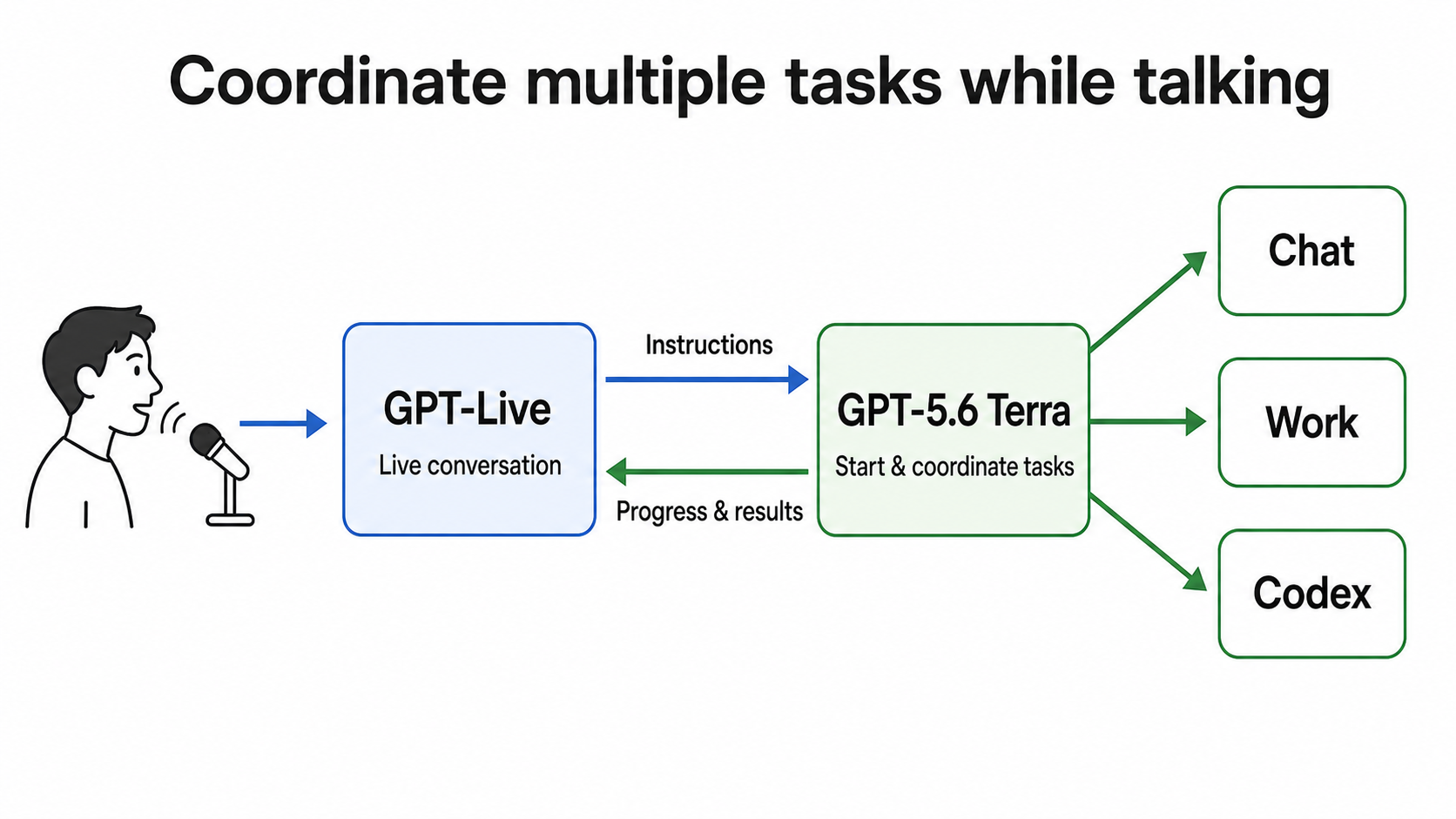
This is more than speech-to-text. A user can keep talking while starting, checking, and redirecting separate tasks in Chat, Work, and Codex.
Release 26.707 brought Codex into the ChatGPT desktop app on July 9. Release 26.715 extends that integration by allowing Voice to coordinate Codex and other tasks.1
The feature is not an always-on, unlimited control channel. Voice and Codex draw from separate allowances, while Screen context can include text outside the visible scroll area. Adoption should begin with permissions, shared context, and dual usage limits, not the novelty of hands-free control.
GPT-Live and GPT-5.6 Terra Divide Conversation from Execution
Desktop Voice combines two models with different responsibilities. OpenAI's pricing page describes a duplex design: GPT-Live manages the live conversation, while GPT-5.6 Terra starts and coordinates tasks in the app.3
| Layer | Model | Responsibility |
|---|---|---|
| Conversation | GPT-Live | Listen, speak, accept interruptions, and maintain the exchange |
| Task coordination | GPT-5.6 Terra | Start, check, and redirect Chat, Work, and Codex tasks |
GPT-Live is the full-duplex voice model OpenAI announced on July 8. It can process input while generating output and delegate search or deeper reasoning to another model without ending the conversation. The general ChatGPT Voice launch delegated to GPT-5.5; the desktop Work and Codex path uses GPT-5.6 Terra for task coordination.35
SmartScope considers this separation more consequential than the voice UI. The conversation layer absorbs waiting time while the execution layer advances multiple threads asynchronously, allowing another instruction before a task finishes.
A Voice Conversation Must Start Before the First Message
A chat or task must begin in Voice mode. Open an empty chat or task and select Start new voice chat before sending the first message. A conversation started in another mode offers dictation, which converts speech into prompt text, rather than ChatGPT Voice.2
An earlier Voice conversation can be reopened with Start voice chat. The shortcut is configurable under Settings > Voice > Voice chat hotkey.
Voice can create a separate thread for long work, check an existing thread, and send follow-up instructions. Progress, blockers, and results return to the original Voice conversation. Voice does not gain extra authority: it follows the same permissions as the Chat, Work, and Codex tasks it directs.2
Screen Context Can Share Text Outside the Visible View
On macOS, enabling Screen context under Settings > Voice lets a user say “Take a look at this” and provide an appshot of the frontmost window.2
An appshot can contain both a window image and accessibility text. That text may extend beyond the visible scroll area. macOS may request Screen and System Audio Recording plus Accessibility permissions.
An organization can disable Screen context. OpenAI's feature table lists Appshots for Plus, Pro, and Business but marks them unavailable for Enterprise and Education.3 Teams should treat the full accessible text of an app as the sharing boundary, not only the information visible on screen.
Voice Time and Codex Work Consume Separate Allowances
Desktop Voice for Work and Codex has a plan-dependent allowance measured over rolling five-hour windows. Tasks launched through Voice separately consume the existing Codex usage budget.23
| Plan | Approximate Voice allowance per five-hour window |
|---|---|
| Plus | 15–30 minutes |
| Pro 5x ($100/month) | 1–2.5 hours |
| Pro 20x ($200/month) | Unlimited Voice |
| Business | 45 minutes |
| Legacy Enterprise/Edu | 45 minutes |
Unlimited Voice on Pro 20x does not make delegated Codex tasks unlimited. For credit-based or pay-as-you-go Business, Edu, and Enterprise workspaces, desktop Voice costs approximately six credits per minute. Only one Voice chat can be active across the desktop app, and Desktop Voice is not currently available through an API key.23
Plus is enough for short trials and status checks. Sustained coordination during a meeting or long development session is more likely to require Pro or metered billing, with Voice time and delegated task usage measured separately.
Voice in Chat and Voice in Work or Codex Have Different Limits
The current Help Center separates ChatGPT Voice into two uses.4
| Use | Main surfaces | Allowance |
|---|---|---|
| Voice in Chat | Desktop Chat and supported web, iOS, and Android experiences | Rolling 24-hour limit |
| Voice in Work and Codex | macOS/Windows desktop and paired iOS Remote | Rolling five-hour Voice limit plus task usage |
At the July 8 launch, the new experience did not include Business, Enterprise, Edu, desktop Work, or Codex. The July 23 release extended it to Work and Codex.14 An older launch note is therefore not sufficient evidence that the desktop experience is unavailable.
Remote itself supports controlling a desktop host from iOS or Android, but the Voice product page currently documents only iOS as its mobile route.26 The public documentation does not confirm Voice in Work and Codex through Android Remote.
Enterprise Adoption Starts with Four Boundaries
- Workspace administrators verify eligibility and rollout settings. Enterprise and Edu begin with a two-week early-access period.
- Security owners define where Screen context is allowed. Appshots can contain accessible text outside the visible area.
- Operations owners record Voice and task usage separately. Conversation duration does not reveal the Codex work running behind it.
- Audit owners test Voice-originated events in their environment. Public documentation lists Compliance API and audit logs, but does not specify the event granularity for tasks started or redirected through Voice.
Approvals remain inside the existing permission model. However, spoken changes across several threads provide less visible context than reviewing each target and patch on screen. High-impact actions should still be checked against the target, diff, and execution result in the UI or audit trail.
Multi-Folder Projects Expand the Execution Side
Release 26.715 also lets a local project include multiple related folders.1 Users can add folders through Edit project and choose one primary folder.
New chats, Git operations, and automatic discovery of AGENTS.md, skills, and config.toml use the primary folder. Secondary folders remain available for search, reading, and editing.
Voice can now coordinate multiple tasks while a local project can reference multiple repositories. The boundary still matters: configuration discovery does not move to secondary folders. In a multi-repository workflow, the primary folder determines the instruction and Git context.
Related Articles
- How GPT-Live Changes Voice Interaction
- Why Codex CLI Voice Input Was Removed
- Orchestrating Codex with a Parent Thread and Worktrees
OpenAI, Codex changelog, “ChatGPT Voice and multi-folder projects 26.715” and “Codex joins the ChatGPT desktop app 26.707.” ↩↩↩↩
OpenAI, Pricing, “ChatGPT Voice in Desktop” and “Feature availability,” accessed July 25, 2026. ↩↩↩↩↩
OpenAI Help Center, ChatGPT Voice, accessed July 25, 2026. ↩↩
OpenAI, Introducing GPT-Live, July 8, 2026. ↩
OpenAI, Remote connections, accessed July 25, 2026. ↩