Claude Code vs Codex: Which Is Better in August 2026?
The short answer
Choose Claude Code for complex, exploratory development and Codex for sustained, high-volume development work. At $20, $100, or $200, the matching Codex plan is the first choice when only one product can be selected. Choose the matching Claude plan instead when root-cause analysis, architecture, and cross-cutting changes dominate; confidence is medium, and the recommendation should be revisited if comparable quota data or representative tasks produce the opposite result.
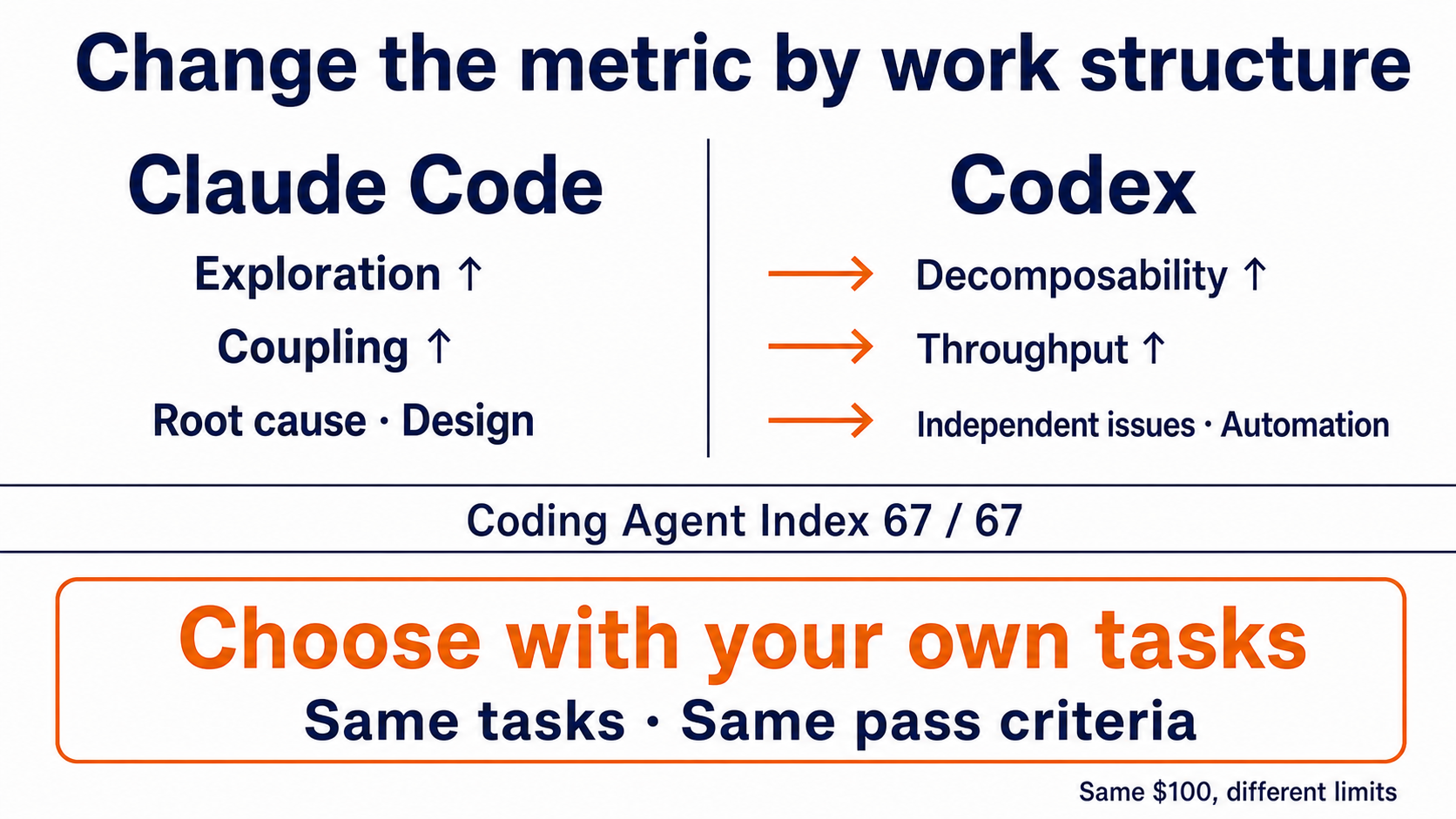
Performance alone no longer decides the choice
Both products support deep reasoning and parallel execution, so feature availability alone does not decide the subscription. Claude Code has subagents, worktrees, experimental Agent Teams, and /batch decomposition into 5–30 worktrees; Codex also has parallel subagents and isolated worktree threads.15 The useful question is therefore whether the work should preserve evolving judgment in one context or be split into independent units.
Choose Claude Code when exploration and coupling are high
Root-cause analysis, architecture changes, and cross-component modifications favor Claude Code first. The next investigation target and required work change as evidence arrives, so the correct task list is not known in advance. Preserving investigated facts, rejected hypotheses, and shared constraints in one primary context matters more than local implementation speed.
Claude Code subagents can move searches into separate contexts and return findings to the main session. Anthropic also positions Opus 5 for long-running, multi-step work, deep codebase understanding, and maintaining the thread of complex tasks.2 This does not prove that only Claude Code can explore, but it supports prioritizing context continuity when exploration and coupling are high.
Choose Codex for large volumes of decomposable work
Independent issues with explicit acceptance criteria and tests favor Codex first. Each thread can run in an isolated worktree, while Sol, Terra, and Luna can be routed by difficulty and volume.6 The advantage is not an inability to handle hard work; it is the fit between high-capability work and a sustained dispatch model.
Claude Code /batch can also parallelize mechanical migrations and independent tasks. For frequent use, however, completion time, corrections, and tokens per task provide a stronger reason to evaluate Codex than raw concurrency does.
The public benchmark ties overall but favors Codex efficiency
The public comparison ties on the aggregate score, while Codex leads on time and token efficiency and Claude Code has the higher SWE-Atlas-QnA result. Artificial Analysis currently displays a Coding Agent Index of 67 for Claude Code with Opus 5 xhigh and Codex with GPT-5.6 Sol max.8
| Metric | Claude Code + Opus 5 | Codex + Sol |
|---|---|---|
| Coding Agent Index | 67 | 67 |
| DeepSWE | 60% | 69% |
| Terminal-Bench v2 | 85% | 88% |
| SWE-Atlas-QnA | 55% | 43% |
| Cost / task | $8.23 | $7.08 |
| Time / task | 23.6 min | 10.2 min |
| Tokens / task | 21.8M | 13.2M |
In this comparison, Codex leads on DeepSWE, Terminal-Bench v2, time, tokens, and cost per task, while Claude Code leads on SWE-Atlas-QnA. The aggregate score does not name a universal winner, but the breakdown supports Codex execution efficiency for frequent implementation. The case for Claude Code on exploratory work comes from its primary-context architecture and Anthropic's product positioning, not from assigning a broader meaning to the benchmark name.
The $20, $100, and $200 tiers use the same decision rule
Both products provide comparable individual-plan tiers at $20, $100, and $200 per month.37
| Monthly budget | Claude Code plan | Codex plan | Default when choosing one |
|---|---|---|---|
| $20 | Claude Pro | ChatGPT Plus | ChatGPT Plus |
| $100 | Claude Max 5x | Codex Pro 5x | Codex Pro 5x |
| $200 | Claude Max 20x | Codex Pro 20x | Codex Pro 20x |
OpenAI estimates 10–100 local Sol messages per five hours on Plus, 50–500 on Pro 5x, and 200–2,000 on Pro 20x.7 Anthropic describes Claude Pro as standard capacity, Max 5x as five times Pro session capacity, and Max 20x as twenty times Pro session capacity, but it does not publish completed-task counts.3 The same-price quotas therefore cannot be compared as completed work.
Codex remains the default at each tier because the public benchmark preserved the aggregate score with less time and fewer tokens. Choose Claude Pro, Max 5x, or Max 20x instead when root-cause analysis, architecture, and cross-cutting work dominate at the corresponding budget. Changing the budget does not change the underlying distinction between exploration and coupling versus decomposition and throughput.
If there is no fixed spending ceiling, both products can continue through additional credits.37 When subscribing to both is acceptable, routing exploratory work to Claude Code and repeatable work to Codex is more useful than forcing a universal winner.
The recommendation splits into three practical cases
| Workload | Recommendation | Reason |
|---|---|---|
| Unexplained incidents, architecture, large legacy changes | Claude Code | Preserve hypotheses and cross-component constraints |
| Ordinary features, explicit bugs, independent issue queues | Codex | Run decomposed implementation quickly and repeatedly |
| One $20 subscription | ChatGPT Plus | Access the GPT-5.6 family and extend usage with credits |
| One $100 or $200 subscription | Matching Codex Pro tier | Keep aggregate performance with better public time and token efficiency |
Public results measure the model and harness together
Tools, prompts, reasoning effort, retries, and context management all affect the result. The Artificial Analysis comparison evaluates the Claude Code and Codex systems; it is not a model-only contest between Opus 5 and Sol. Its cost per task also follows the evaluator's public-price methodology rather than measuring subscription quota consumption. The evidence therefore cannot support a claim that Codex Pro completes a specific number of additional monthly tasks.
That limitation qualifies the recommendation without erasing it. Start with the Codex plan that fits the budget, then switch toward Claude Code if exploratory work dominates or human correction time increases. If a contract, compliance rule, or existing-platform constraint specifies a product, follow that requirement.
A short trial should test only the reversal conditions
When a trial is possible, run the same unexplained incident, cross-component change, and independent issue queue in both products. Record success, time to first passing result, human correction time, and quota reduction. Make the first purchase from the recommendation above, then change the allocation only if one week of results meets a replanning condition.
Sources
This article reflects public information available on August 16, 2026. Models, prices, limits, and experimental features can change; recheck the official pages before subscribing.
Related articles
- GPT-5.6 Sol vs Claude Fable 5: Why the evaluations split
- Claude Code vs Codex: Compaction design for long-running tasks
- How to choose among ChatGPT Chat, Work, and Codex
Anthropic, Create custom subagents, Orchestrate teams of Claude Code sessions, and Slash commands. ↩
Anthropic, Introducing Claude Opus 5, July 24, 2026. ↩
Anthropic Help Center, Choose a Claude plan and Use Claude Code with your Pro or Max plan. ↩↩↩
Anthropic, Manage costs effectively and Model configuration. ↩
OpenAI, Codex subagents and Git worktrees. ↩
OpenAI, Codex models and Using GPT-5.6. ↩
OpenAI, Codex pricing. ↩↩↩
Artificial Analysis, Claude Code vs Codex, accessed August 16, 2026. ↩