Choosing GitHub Copilot Models in 2026: Routing Eight Models by Effective Cost
Set these routing defaults first
| Work | First choice and switching condition |
|---|---|
| Routine edits and summaries | Start with Luna and also test MAI-Code-1.1-Flash for autonomous code changes |
| Daily implementation and tests | Start with MAI-Code-1.1-Flash and replace it if Luna lowers effective cost per success |
| Design decisions and first review | Start with Terra and escalate only work below the quality threshold |
| Long-lived CI and platform automation | Use GPT-5.3-Codex and move to Terra when current performance matters more than LTS |
On June 1, 2026, GitHub Copilot monthly plans moved from premium-request multipliers to GitHub AI Credits.2 Current model cost comes from model-specific prices for input, cached, and output tokens. Choosing a cheap model is therefore insufficient: measure the credits, success rate, and human correction time required to finish the same job.
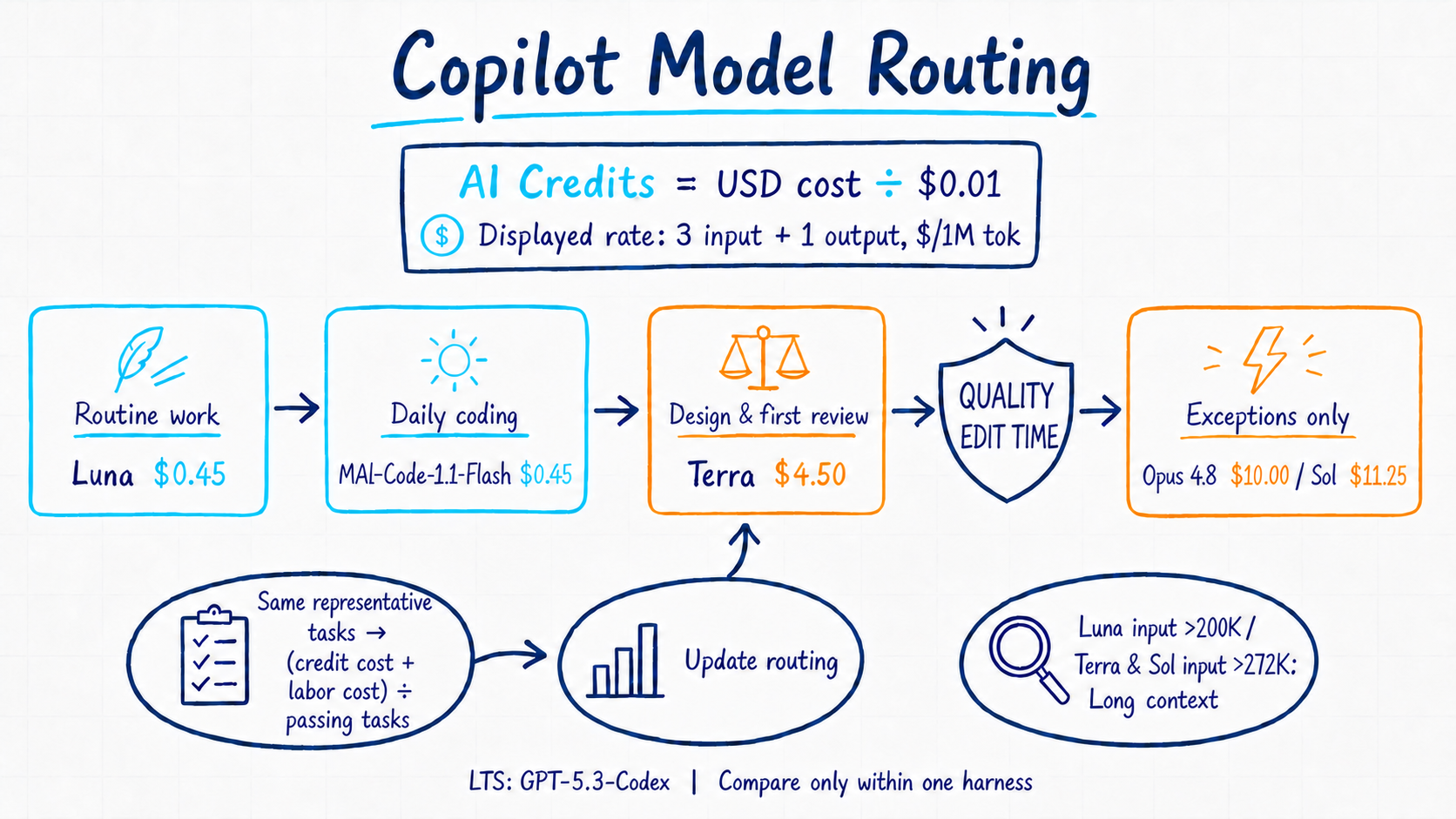
The practical answer is a three-tier MAI, Luna, and Terra route
SmartScope provisionally routes the selected eight models below, identifying where to test and remove each model instead of claiming an overall ranking across incompatible harnesses.
| Model | Trial lane | Adoption or removal condition |
|---|---|---|
| MAI-Code-1.1-Flash | Daily implementation | Make it the default if effective cost per success beats same-price Luna |
| GPT-5.6 Luna | Routine and low-cost general work | Also take coding tasks where it beats MAI on effective cost per success |
| GPT-5.6 Terra | Design decisions and first review | Fix reasoning level and compare it with Luna and Sol settings |
| GPT-5.3-Codex | Long-lived automation | Use when Business and Enterprise LTS matters more than recency |
| Claude Opus 4.8 | Difficult review in this selected set | Compare same-price Opus 5 before adopting it |
| GPT-5.6 Sol | Hardest terminal-heavy work | Route only work that misses the quality threshold with Terra |
| MAI-Code-1-Flash | Migration to 1.1 | Replace it before its September 10, 2026 retirement |
| Claude Haiku 4.5 | Existing compatibility | Remove it as a default when MAI produces lower effective cost per success |
MAI-Code-1.1-Flash and Luna have the same GitHub price, but no public head-to-head result from the same Copilot harness. Start daily coding with Copilot-optimized MAI-Code-1.1-Flash and routine work with Luna, then exchange responsibilities based on repository effective cost per success.
Token consumption replaced the multiplier as the billing unit
One GitHub AI credit represents $0.01 USD. Individual plans include monthly allowances, while Business and Enterprise pool per-seat allowances across the billing entity. Usage beyond the allowance is billed using the model's input, cache-read, cache-write, and output prices.1
Code completions and next edit suggestions do not consume AI Credits and remain unlimited on paid plans. The selected model affects billing mainly in chat, agent, and similar workloads. Copilot code review is an exception: GitHub automatically selects an undisclosed model, and the review consumes GitHub Actions minutes in addition to AI Credits.1 Terra can be selected manually for a first review only by asking chat or an agent to review a diff, not inside the built-in code review feature.
The exception is an existing annual Copilot Pro or Pro+ subscription that remains on request-based billing until renewal. Those users can keep the old system, but may not receive new models and features.3 The current legacy table gives GPT-5.3-Codex a 6x multiplier, not 0x.
Read output and cache-write prices as separate cost drivers
The following GitHub list prices were checked on August 14, 2026 and are in US dollars per million tokens.1 The 3:1 blend assumes three input tokens for one output token and excludes cache-write charges.
| Model | Input | Cache read | Cache write | Output | 3:1 blend |
|---|---|---|---|---|---|
| MAI-Code-1.1-Flash | $0.20 | $0.02 | — | $1.20 | $0.45 |
| GPT-5.6 Luna | $0.20 | $0.02 | $0.25 | $1.20 | $0.45 |
| MAI-Code-1-Flash | $0.75 | $0.075 | — | $4.50 | $1.69 |
| Claude Haiku 4.5 | $1.00 | $0.10 | $1.25 | $5.00 | $2.00 |
| GPT-5.6 Terra | $2.00 | $0.20 | $2.50 | $12.00 | $4.50 |
| GPT-5.3-Codex | $1.75 | $0.175 | — | $14.00 | $4.81 |
| Claude Opus 4.8 | $5.00 | $0.50 | $6.25 | $25.00 | $10.00 |
| GPT-5.6 Sol | $5.00 | $0.50 | $6.25 | $30.00 | $11.25 |
Actual cost does not come from the last column alone. Repository reads, reasoning length, failed tool calls, retries, and human correction time all contribute to the cost of one successful task.
Long context tiers add another boundary. Luna moves to long-context pricing above 200,000 input tokens, while Terra and Sol do so above 272,000. Sending an unfiltered large repository can increase both the rate and the number of billed tokens.
Compare benchmark values only inside the same harness
OpenAI's general-availability table reported SWE-Bench Pro scores of 64.6 for Sol, 63.4 for Terra, and 62.7 for Luna. Its Terminal-Bench 2.1 results were 88.8, 87.4, and 84.7 respectively, with Sol Ultra at 91.9.7
| Same OpenAI evaluation | SWE-Bench Pro | Terminal-Bench 2.1 | Agents' Last Exam |
|---|---|---|---|
| GPT-5.6 Sol | 64.6 | 88.8 | 52.7 |
| GPT-5.6 Terra | 63.4 | 87.4 | 50.4 |
| GPT-5.6 Luna | 62.7 | 84.7 | 50.3 |
| Claude Opus 4.8 | 69.2 | 78.9 | 45.2 |
The table supports two narrow conclusions: Terra remains close to Sol, and Luna's lower price does not imply a proportionate evaluation drop. It does not justify copying numbers into a table from providers that used different effort settings, tools, containers, or trial counts.
GPT-5.3-Codex scored 56.8 on SWE-Bench Pro and 77.3 on Terminal-Bench 2.0 in a separate OpenAI release evaluation.8 The Terminal-Bench version differs, so 77.3 does not belong in the Terminal-Bench 2.1 ranking above.
Microsoft's latest model card evaluates MAI-Code-1.1-Flash with the harness used for production Copilot workflows.9
| Microsoft Copilot harness | SWE-Bench Verified | Avg. tokens | Terminal-Bench 2.1 | Avg. tokens |
|---|---|---|---|---|
| MAI-Code-1.1-Flash | 72.6 | 8.6K | 62.9 | 17.0K |
| MAI-Code-1-Flash | 71.6 | 10.8K | 51.7 | 14.2K |
| Claude Haiku 4.5 | 69.8 | 20.9K | 49.4 | 25.5K |
This table supports direct comparison between MAI-Code-1.1-Flash and Haiku 4.5, but it cannot rank them against the OpenAI table. The earlier MAI-Code-1-Flash model card also reported different Haiku 4.5 baselines: 66.6 on Verified and 41.6 on Terminal-Bench 2.0.10 Even successive cards from one vendor can move a baseline, so this article prioritizes comparisons within the newest single card.
MAI-Code-1.1-Flash is the first daily-coding candidate
MAI-Code-1.1-Flash is trained for agentic workflows in GitHub Copilot. Microsoft reports gains over the first generation on Terminal-Bench 2.1, streaming speed, and token efficiency.9
If the card's average token count is treated as output for a deliberately simple price proxy, one SWE-Bench Verified task costs about $0.010 for MAI-Code-1.1-Flash and $0.105 for Haiku 4.5. The same card reports scores of 72.6 and 69.8, making the MAI proxy roughly one tenth as expensive while scoring higher.
This proxy is not an invoice. It excludes input, cache, and failed attempts, and the published average-token field is not necessarily all output. It still supplies a sound reason to begin a repository trial with MAI-Code-1.1-Flash: shorter solutions and a higher success rate appear in the same harness.
Luna owns the same-price general-purpose lane
Luna has the same GitHub list price as MAI-Code-1.1-Flash. Within OpenAI's evaluation, it trails Sol by 1.9 points on SWE-Bench Pro and 2.4 points on Agents' Last Exam.7
It is a candidate for summaries, classification, commit messages, routine explanations, and code changes. Because no public Copilot-harness comparison with MAI-Code-1.1-Flash exists, let effective cost per success in your repository decide which model becomes the default.
Test Terra in the middle lane with a fixed reasoning level
Terra trails Sol by 1.2 SWE-Bench Pro points while its 3:1 blended list price is 40% of Sol's. Current Copilot supports configurable reasoning for GPT-5.6 and other eligible models, and higher reasoning consumes more AI Credits.5 The control is available in Visual Studio Code, Copilot CLI, and Copilot cloud agent, so a model name alone cannot define effective cost.
Artificial Analysis found a different result for configurable API use: Luna and Sol remained on the Pareto frontier across reasoning settings while Terra fell behind it.12 Use Terra at regular reasoning as the design-work starting point, then test whether high-reasoning Luna or low-reasoning Sol reaches the same quality more cheaply on the same repository tasks.
GPT-5.3-Codex sells LTS rather than a higher benchmark rank
GitHub designates GPT-5.3-Codex as a base and LTS model for Copilot Business and Enterprise. LTS models are intended to remain available for one year after designation, reducing revalidation work caused by model retirement.4
Terra's 3:1 blended price is $4.50 versus $4.81 for GPT-5.3-Codex, but SWE-Bench Pro scores from separate releases do not establish a direct performance difference. For CI repair or a long-lived agent platform, the stable model window can matter more than the small nominal-price gap.
Restrict Opus 4.8 and Sol to difficult work
In OpenAI's same evaluation table, Claude Opus 4.8 scores 69.2 on SWE-Bench Pro, above Sol's 64.6, but 78.9 on Terminal-Bench 2.1, below Sol, Terra, and Luna.7 Within this selected eight-model set, it is a candidate for a second look at large refactors and architecture reviews, without assuming the same advantage for terminal-heavy work.
Its GitHub output price is $25 per million tokens. Artificial Analysis also measures above-average output length and a high per-task cost.13 Anthropic says its newer tokenizer can map the same input to 1.0 to 1.35 times as many tokens depending on content, while some internal coding evaluations used fewer total tokens.11 The tokenizer change is not a universal 35% price increase; measure the total consumption required to finish.
Sol reaches 91.9 on Terminal-Bench 2.1 in Ultra mode, but it also has the highest 3:1 blended price in this set. Reserve it for terminal-heavy work that fails the quality threshold with Terra or Opus 4.8.
This provisional route covers the eight specified models, not the complete Copilot catalog. GitHub's August 14, 2026 price table lists Claude Opus 5 at the same price as Opus 4.8, so compare the successor before fixing Opus 4.8 as a new default.1
Do not make MAI-Code-1-Flash or Haiku 4.5 a new default
MAI-Code-1-Flash beat Haiku 4.5 on several coding evaluations and average token use in Microsoft's same Copilot harness.10 Its 1.1 successor then reduced the list price and improved Verified and Terminal-Bench 2.1 results. GitHub will deprecate MAI-Code-1-Flash across all Copilot experiences on September 10, 2026 and names version 1.1 as the replacement.6 The older model is therefore a migration target, not a new default.
Copilot Business and Enterprise administrators must enable the MAI-Code-1.1-Flash model policy, which is off by default.6 Confirm that version 1.1 appears in the team's model picker before starting the repository trial.
Haiku 4.5 has lower scores, longer average solutions, and a higher GitHub price than MAI-Code models in the direct Microsoft comparison. Keep it only when Anthropic-specific behavior or existing prompt compatibility survives an explicit evaluation.
Measure effective cost per successful repository task
Instead of predicting internal success from a public leaderboard, extract a fixed set of representative tasks. Include bug fixes, test additions, refactors, CI repairs, and design review, and define the expected test result and human grading criteria first.
Record at least the following for every model:
- pass or fail and attempts to first pass;
- input, cache, and output AI Credits;
- model name, reasoning level, and context setting;
- elapsed time and human correction time;
- failed tests, unnecessary diffs, and security issues;
- whether the run entered long-context pricing.
First require the quality threshold and a ceiling on human correction time, then compare only passing candidates with effective cost per success = (total AI Credits × $0.01 + total correction hours × internal hourly cost) / passed tasks. Run MAI-Code-1.1-Flash and Luna head to head for daily coding, begin decision-heavy work with Terra, and escalate only the failures.
Five checks before adoption
- Compare monthly-plan cost by token rates and actual consumption, not request multipliers.
- Start daily implementation with MAI-Code-1.1-Flash and low-cost general work with Luna.
- Start decision-heavy work with Terra, reserving Opus 4.8 and Sol for expensive failures.
- Choose GPT-5.3-Codex for Business and Enterprise LTS requirements, not a legacy multiplier.
- Read public scores only within one harness, then measure effective cost per success only among candidates that meet the quality and correction-time limits.
Related Articles
- How to choose GPT-5.6 Sol, Terra, and Luna
- GPT-5.3-Codex performance and agent operations
- How to allocate pooled AI Credits across teams
- Designing model routing with AI FinOps
Sources
GitHub Docs, Models and pricing for GitHub Copilot, accessed August 14, 2026. Used for AI Credit conversion, plan allowances, pooling, overages, excluded features, model prices, long-context tiers, and promotional prices. ↩↩↩↩
GitHub, Updates to GitHub Copilot billing and plans, June 1, 2026. Used for the monthly-plan transition date and annual-plan boundary. ↩
GitHub Docs, Model multipliers for annual plans, accessed August 14, 2026. Used for legacy eligibility, new-model restrictions, and the current GPT-5.3-Codex multiplier. ↩
GitHub Docs, Base and LTS models, accessed August 14, 2026. Used for Business and Enterprise scope, GPT-5.3-Codex designation, and intended availability. ↩
GitHub Docs, Supported AI models in GitHub Copilot, accessed August 14, 2026. Used for configurable reasoning on GPT-5.6, supported clients, and the AI Credits impact of higher reasoning and larger context. ↩
GitHub, Upcoming deprecation of MAI-Code-1-Flash, August 11, 2026, and MAI-Code-1.1-Flash available in GitHub Copilot, August 11, 2026. Used for the retirement date, replacement, availability, and the default Business and Enterprise policy state. ↩↩
OpenAI, GPT-5.6 is now generally available, updated July 30, 2026. Used for the GPT-5.6 tiers and same-table SWE-Bench Pro, Terminal-Bench 2.1, and Agents' Last Exam values. ↩↩↩
OpenAI, Introducing GPT-5.3-Codex, February 5, 2026. Used for published SWE-Bench Pro and Terminal-Bench 2.0 values. ↩
Microsoft AI, MAI-Code-1.1-Flash Model Card and MAI-Code-1.1-Flash: Better, faster, at a quarter of the cost, August 11, 2026. Used for the Copilot harness, SWE-Bench Verified, Terminal-Bench 2.1, average tokens, speed, and first-generation comparison. ↩↩
Microsoft AI, MAI-Code-1-Flash Model Card, June 2, 2026. Used for the same-harness comparison with Claude Haiku 4.5. ↩↩
Anthropic, Introducing Claude Opus 4.7, April 16, 2026. Used for the input-token range under the new tokenizer and internal total-token comparison. ↩
Artificial Analysis, GPT-5.6 has landed, July 9, 2026. Used for independent price-performance curves and the Luna, Sol, and Terra Pareto assessment. ↩
Artificial Analysis, Claude Opus 4.8 — Intelligence, Performance & Price Analysis, accessed August 14, 2026. Used for independent output-length, per-task cost, and speed measurements. ↩