Why Giving Every Employee AI Breaks Down: From License Management to AI FinOps
Decide this before renewing licenses
| Current state | Next unit of management |
|---|---|
| Only seat count and adoption are visible | Cost by department, application, and workflow |
| Everyone receives the same default model | Routing rules for routine and difficult work |
| Budget overruns stop access | Cheaper-model fallback plus an exception process |
Enterprise AI has moved beyond the point where distributing accounts completes the rollout. Once AI agents join chat applications, one employee can generate vastly different request volumes and compute demand from another.
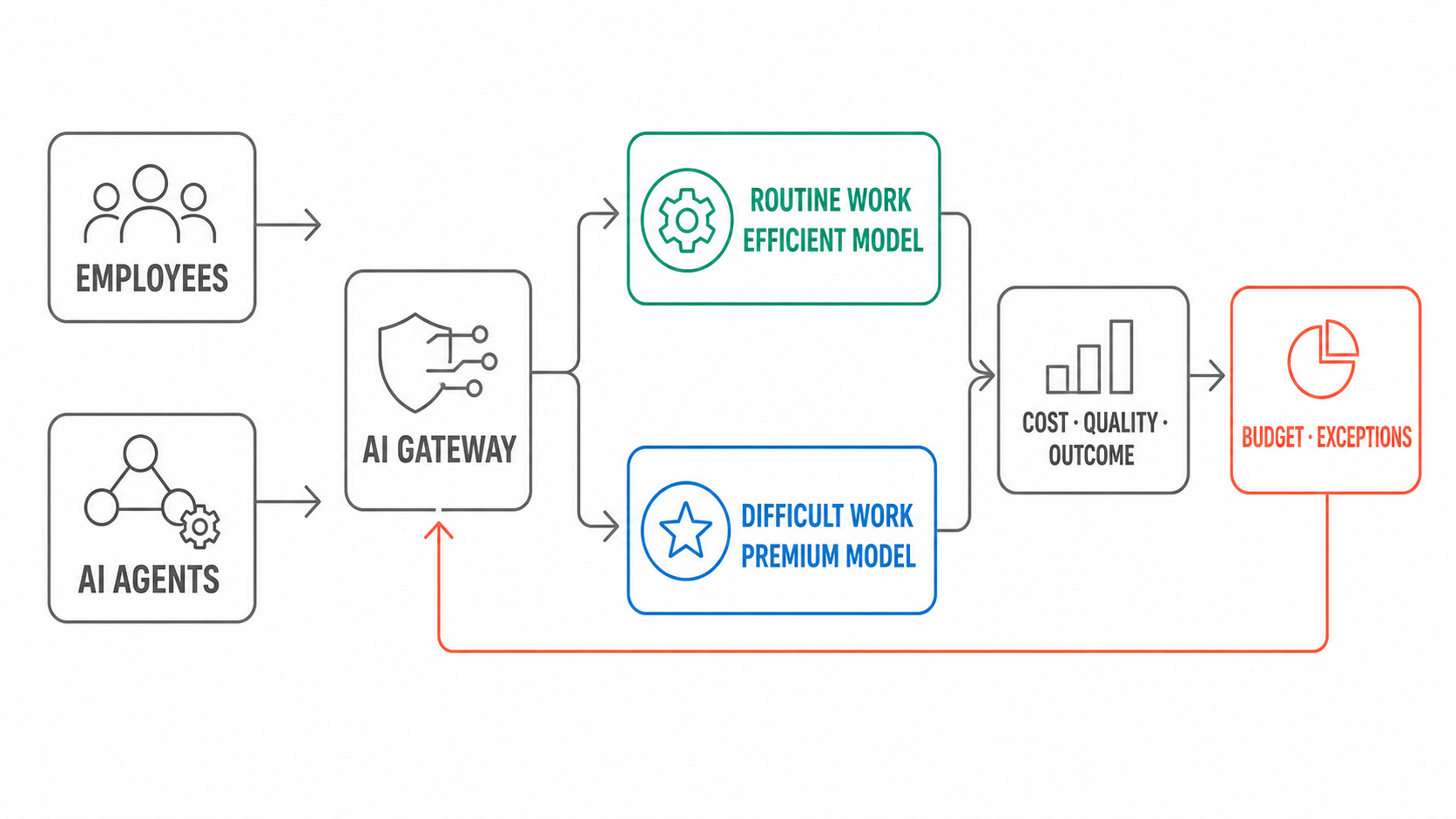
The management unit therefore shifts from seats to compute allocation. AI FinOps decides which model and budget a person or workflow receives while preserving the quality that the work requires.
Seat count does not describe agent consumption
Traditional SaaS budgets are often estimated from headcount and a monthly unit price. Generative AI combines seats with included allowances, paid overages, and token-metered APIs.
Pricing layers subscriptions and consumption
Anthropic Team can mix standard and premium seats, while Enterprise combines a per-seat platform fee with usage charges that vary by model and task. Claude Code is included in paid plans, with API credits available for additional usage. Usage analytics and spend controls are also available.1 Google Workspace places Gemini capabilities inside user-based plans, producing a different cost surface.2
| Pricing structure | Budget advantage | Cost that is easy to miss |
|---|---|---|
| Per-user subscription | Predictable annual baseline | Unused seats and excessive premium seats |
| Seat plus overage | Separates standard and exceptional use | Overage hidden from departmental owners |
| Token-metered API | Attributes cost to actual processing | Agent loops and retries |
| Shared organization pool | Absorbs uneven user demand | One workload consumes the common pool |
A seat proves access, not consumption. An agent can continue reasoning, calling tools, and retrying failures while no employee is watching the screen.
The 2026 controls exposed the limit of adoption metrics
In 2026, several companies that had encouraged AI adoption were reported to be introducing spend limits and usage visibility. These accounts concern internal operations and are not public audits. Their shared signal is that organizations which used consumption as a proxy for progress began asking what the consumption produced.
| Company | Reported response | Operating lesson |
|---|---|---|
| Uber | Used its annual AI budget in four months and set a $1,500 monthly cap per employee per tool | Preserve exceptions instead of banning use |
| Atlassian | Assigned role-based AI wallets of $500 to $2,000 per month to R&D staff | Combine role budgets with additional approval |
| Disney | Displayed request counts and token use in an internal dashboard | Usage ranking can reward waste |
| Amazon | Removed an unofficial internal AI-usage leaderboard | Do not treat consumption as productivity |
Uber's limit was not an AI ban. It made tool-level cost visible and moved overage into an approval process.3 Atlassian's wallet similarly combines warnings, a stopping point, and a path to request more.4
Disney and Amazon show that visibility is not neutral. When tokens become a leaderboard, employees can rationally optimize the metric without improving business output.56
Changing the default model reaches more work than a uniform cap
A cap stops extreme consumption but does not lower the unit cost of ordinary work. If the premium model remains the default, the majority of requests that never approach the cap still run at the higher price.
An AI gateway gives an organization one place to handle identity, usage records, rate limits, and model selection. AWS describes the gateway pattern as a way to govern model access with authorization, quotas, tenant isolation, and cost control.7
The allocation sequence can be concrete.
- The AI platform team makes an efficient model the default for routine work.
- The gateway narrows eligible models by data class, workflow, and required quality.
- Only evaluated difficult workloads are escalated to premium models.
- The gateway records cost and quality by user, team, application, and workflow.
- Budget overruns fall back to a cheaper model, while an owner approves necessary exceptions.
Fallback is not appropriate for every workload. Legal judgments, customer-impacting output, and workflows without comparative evaluations must prioritize quality and review over cost.
AI FinOps manages business value rather than token price
The FinOps Foundation's 2026 Framework treats AI as a distinct Technology Category. Its guidance points to granular costs, forecast uncertainty, cross-category spending, and complex allocation.8
Token count alone cannot establish enterprise value. One million tokens that shorten customer-resolution time and one million tokens spent in an unnecessary loop have different outcomes.
| Management layer | Minimum record | Decision owner |
|---|---|---|
| Request | Model, input and output tokens, retries, latency | AI platform team |
| Workflow | Purpose, quality target, volume, human corrections | Business owner |
| Budget | Department, application, exception usage | Finance and department owner |
| Outcome | Time saved, revenue, resolution rate, incidents | Business owner and executives |
AI FinOps is not a cost-cutting program alone. The FinOps Foundation defines the practice around data-driven decisions, financial accountability, and maximizing the business value of technology through collaboration.9
A gateway reduces lock-in without eliminating it
A shared gateway can normalize access across providers and centralize failover and usage records. AWS's multi-provider reference architecture includes load balancing, failover, prompt caching, and role-based model restrictions.10
API normalization does not remove these dependencies:
- model-specific prompts and evaluation data;
- proprietary tools, agent features, and context management;
- RAG authorization and audit design;
- differences in output quality, latency, and safety.
Making every workload model-independent can also discard provider-specific strengths. Normalize high-frequency, expensive workloads whose quality can be compared, while retaining direct integrations where a proprietary capability produces measurable value.
The first 30 days should establish allocation rules
A spending cap has no evidence behind it when the organization cannot identify current cost owners. Use the first 30 days to build the allocation rules.
- The AI platform team tags every model request with department, application, and workflow.
- Business owners define minimum quality and the outputs that require human review.
- Finance and the platform team set normal budgets, warning levels, stop levels, and exception owners.
- The platform team makes an efficient model the default and escalates only evaluated workflows.
- Executives and business owners review cost, quality, latency, and business outcomes in one monthly view.
Do not automate model routing when no evaluation set can detect quality regressions. Build workload-level measurement and human approval first.
Related Articles
- Designing audit logs and operating cost for AI adoption
- Using LiteLLM as a common entry point for multiple models
- Why AI adoption stops at PoC
Sources
Anthropic, Pricing, accessed August 5, 2026. The page describes Team seat types, the Enterprise platform fee and usage charges, spend controls, usage analytics, and additional Claude Code usage. ↩
Google, Google Workspace pricing, accessed August 5, 2026. The page presents Workspace plans, including Gemini capabilities, on a per-user basis. ↩
TechCrunch, Uber caps employee AI spending after blowing through budget in 4 months, June 2, 2026. It attributes the $1,500 cap to Bloomberg and the four-month budget figure to The Information. ↩
TNW, Atlassian puts its engineers on an AI budget as the cost of tokenmaxxing bites, July 30, 2026. The report includes a statement from Atlassian. ↩
HR Executive, From Disney to Meta, tokenmaxxing is exposing AI's measurement problem, June 16, 2026. The account is based on Business Insider reporting about an internal dashboard. ↩
InfoWorld, Amazon deletes devs' tokenmaxxing leaderboard to minimize costs, May 29, 2026. The account is based on Financial Times reporting about internal operations. ↩
AWS, Building an AI gateway to Amazon Bedrock with Amazon API Gateway, November 19, 2025. ↩
FinOps Foundation, FinOps for AI, accessed August 5, 2026. ↩
FinOps Foundation, FinOps Framework 2026, March 19, 2026. ↩
AWS, Streamline AI operations with the Multi-Provider Generative AI Gateway reference architecture, November 21, 2025. ↩