Meta Muse Code Benchmarks: Did Muse Spark 1.2 Catch Claude Opus 5 and GPT-5.6?
Start with the deployment decision
| Requirement | Current choice |
|---|---|
| Maximize success on long-running work | Keep Claude Opus 5 or GPT-5.6 Sol as the baseline |
| Reduce unit cost for retryable bulk work | Evaluate standard-tier Muse Spark 1.2 on real tasks |
| Use the Contributor tier | Have legal and security approve the data terms first |
Meta released the beta of Muse Code and Muse Spark 1.2 on August 5, 2026, positioning a terminal agent that plans work, changes code, invokes tools, and verifies results against Claude Code and Codex.1Claude Opus 5 outscored Muse Spark 1.2 on all three coding evaluations shown by Meta. Muse Spark 1.2's standard API price is much lower, making cost per completed task more important than the highest headline score alone.
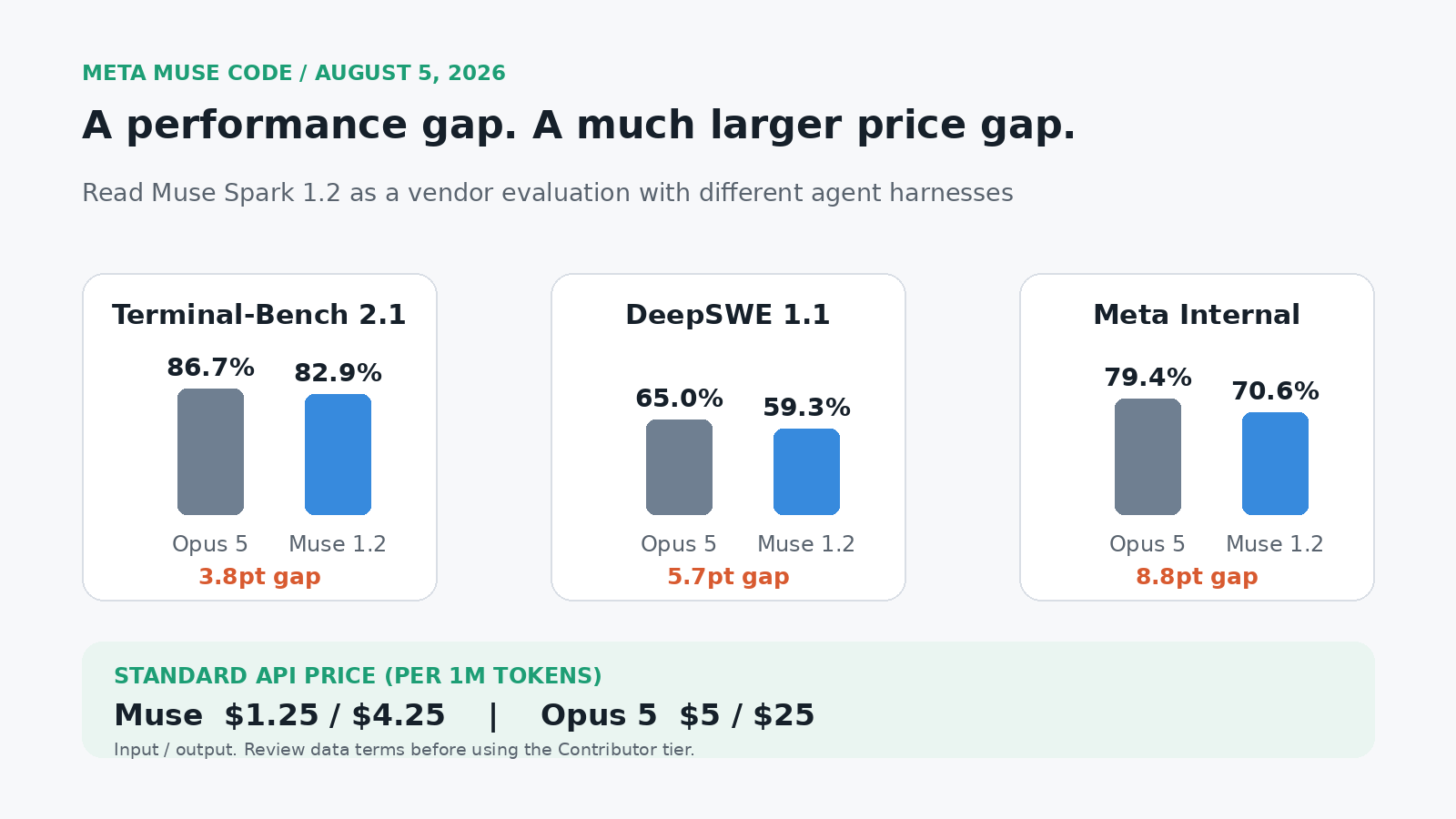
Claude Opus 5 leads all three published coding evaluations
Meta reports the following results, with Terminal-Bench 2.1 and DeepSWE 1.1 pairing each model with a selected first-party or associated agent product.1
| Benchmark | Muse Spark 1.2 (Muse Code) | Claude Opus 5 (Claude Code, max) | GPT-5.6 Terra (Codex, max) |
|---|---|---|---|
| Terminal-Bench 2.1 | 82.9% | 86.7% | 81.8% |
| DeepSWE 1.1 | 59.3% | 65.0% | 64.8% |
| Meta Internal Coding Bench, 440 tasks | 70.6% | 79.4% | 65.4% |
Muse Spark 1.2 beats GPT-5.6 Terra by 1.1 points on Terminal-Bench 2.1, but trails Terra by 5.5 points on DeepSWE 1.1 and Opus 5 by 8.8 points internally. The same charts put Grok 4.5 at 81.6% and 56.6% on the two public benchmarks.
Beating Terra does not establish parity with the strongest Codex model
GPT-5.6 Sol is absent from Meta's chart. OpenAI positions Sol as the GPT-5.6 flagship and Terra as the model that balances intelligence and cost.34 Beating Terra on one benchmark therefore does not establish parity with the strongest Codex configuration.
The generation gain mixes model and harness improvements
Meta's chart shows Muse Spark 1.2 improving over 1.1 by 6.7 points on Terminal-Bench 2.1 and 6.3 points on DeepSWE 1.1.1 The two generations did not run in the same agent: 1.1 used mini-swe-agent, while 1.2 used Muse Code.
Meta's methodology says the official DeepSWE leaderboard uses mini-swe-agent for every model, whereas this evaluation uses a selected product for each model and is not harness-identical.2 The change therefore combines the model, tools, system prompt, compaction, and subagent design.
That is valid for a product comparison because buyers use the full agent. It cannot isolate a 6-point improvement in the model itself.
The price gap is larger than the benchmark gap
Standard Muse Spark 1.2 pricing is $1.25 per million input tokens and $4.25 per million output tokens.7 GPT-5.6 Terra is $2 and $12, Claude Opus 5 is $5 and $25, and GPT-5.6 Sol is $5 and $30.453
| Model | Input | Output |
|---|---|---|
| Muse Spark 1.2, Contributor | $0.10 | $0.20 |
| Muse Spark 1.2, standard | $1.25 | $4.25 |
| GPT-5.6 Terra | $2.00 | $12.00 |
| Claude Opus 5 | $5.00 | $25.00 |
| GPT-5.6 Sol | $5.00 | $30.00 |
At one million input and 200,000 output tokens, the simple totals are $2.10 for standard Muse, $4.40 for Terra, and $10 for Opus 5.
These list-price totals are not workload costs. Opus 5 cached input is $0.50 per million tokens, and Batch API processing discounts input and output by 50%.6 Thinking tokens are billed as output, so token volume also changes by model and effort level.
The Contributor tier changes the data boundary
The Contributor tier is listed at $0.10 input and $0.20 output per million tokens.7 That is 12.5 times below standard input pricing and 21.25 times below standard output pricing.
The tier is tied to contributing usage data for model improvement. Repositories containing customer data, unreleased code, or vulnerability details should not enter it based on price alone. Meta's public developer page currently requires authentication, so region availability, retention, training use, opt-out, and deletion procedures must be checked against the terms shown when contracting.
A company evaluation should start in the standard tier.
- Security classifies repositories and prohibited data.
- Legal verifies training, retention, subprocessors, and deletion terms.
- The developer platform team tests access control and audit logs.
- Procurement obtains written confirmation of any zero-data-retention terms it requires.
Muse Code differentiates through persistence and isolated work
Muse Code includes specialized background agents that remain active during a session and parallel subagents that work in isolated worktrees.1 It appends model calls, approvals, edits, and tool invocations to an event log designed to support recovery of long-running work.
The installer targets macOS and Linux. The public launch page does not list a native Windows build, so Windows organizations need a separate WSL operating model and security review.
Meta also demonstrates more than 1,000 tool calls over as long as 24 hours while optimizing NVIDIA Hopper kernels.1 That demonstrates long-horizon execution, not independent reliability across ordinary enterprise repositories.
A vendor evaluation is not a procurement scorecard
Meta evaluates all 89 Terminal-Bench 2.1 tasks and 113 DeepSWE 1.1 tasks, reporting average pass@1 across five attempts.2 Its internal benchmark uses 440 tasks derived from real pull requests with two attempts per task.
Meta also says its tools and system prompts may not be tuned for proprietary third-party models and may not reflect their best performance in tailored environments.2 The chart therefore combines three factors:
- model capability;
- agent-product design;
- Meta's evaluation framework and configuration.
A procurement evaluation should use real migrations, tickets, and failure-recovery cases. Record input and output tokens, retries, elapsed time, and human correction effort alongside task success.
Deployment should be decided by cost per completed task
Opus 5 or GPT-5.6 Sol remains a rational baseline when long-running autonomy matters and one mistake can contaminate downstream work. A few benchmark points can matter if failed runs create expensive rework.
Standard-tier Muse Spark 1.2 is worth testing for bulk refactoring, test generation, and mechanically verifiable fixes where failures are cheap to detect and retry. Limit the Contributor tier to repositories whose code may be contributed under approved terms.
Run the same 20 to 50 tasks across candidates and compare:
Completion cost = API spend + human review time + failed-run retry cost
The launch chart can narrow a shortlist. Only measured completion cost in the organization's own repositories can support replacement.
Related Articles
- Understanding GPT-5.6 Sol, Terra, and Luna
- Claude Opus 5 benchmarks and deployment decisions
- Moving enterprise AI from seat management to AI FinOps
Sources
Meta AI Research, Introducing Muse Code and Muse Spark 1.2, August 5, 2026. ↩↩↩↩↩
Meta AI Research, Muse Spark 1.2 & Muse Code Evaluation Methodology, August 5, 2026. ↩↩↩
OpenAI, GPT-5.6 Sol, accessed August 6, 2026. ↩↩
OpenAI, GPT-5.6 Terra, accessed August 6, 2026. ↩↩
Anthropic, Models overview, accessed August 6, 2026. ↩
VentureBeat, Meta enters the AI coding wars with Muse Spark 1.2 and Muse Code, August 5, 2026. The figures are reported from Meta's authenticated developer pricing display; current contract terms should be checked at sign-up. ↩↩