Was SpaceX's Cursor Acquisition a Side Note? How Origin Could Loosen GitHub's Grip
The answer first
On August 17, 2026, Cursor released Origin in early beta on the same day a major GitHub.com incident disrupted developers. The SpaceX acquisition is not merely a side note: it reinforces Cursor's broader, though still inferred, move from code generation into an integrated development platform. Origin is not replacing GitHub immediately; its synchronization model lowers the friction of trying an alternative. That synchronization, however, is not a complete failover for a GitHub outage.12
| Decision for a technical leader | Current position |
|---|---|
| Test code and AI agents together | Pilot a non-critical repository |
| Reduce GitHub outage exposure | Prioritize backups and portable CI/CD |
| Move the production source of truth | Wait for mature controls and recovery evidence |
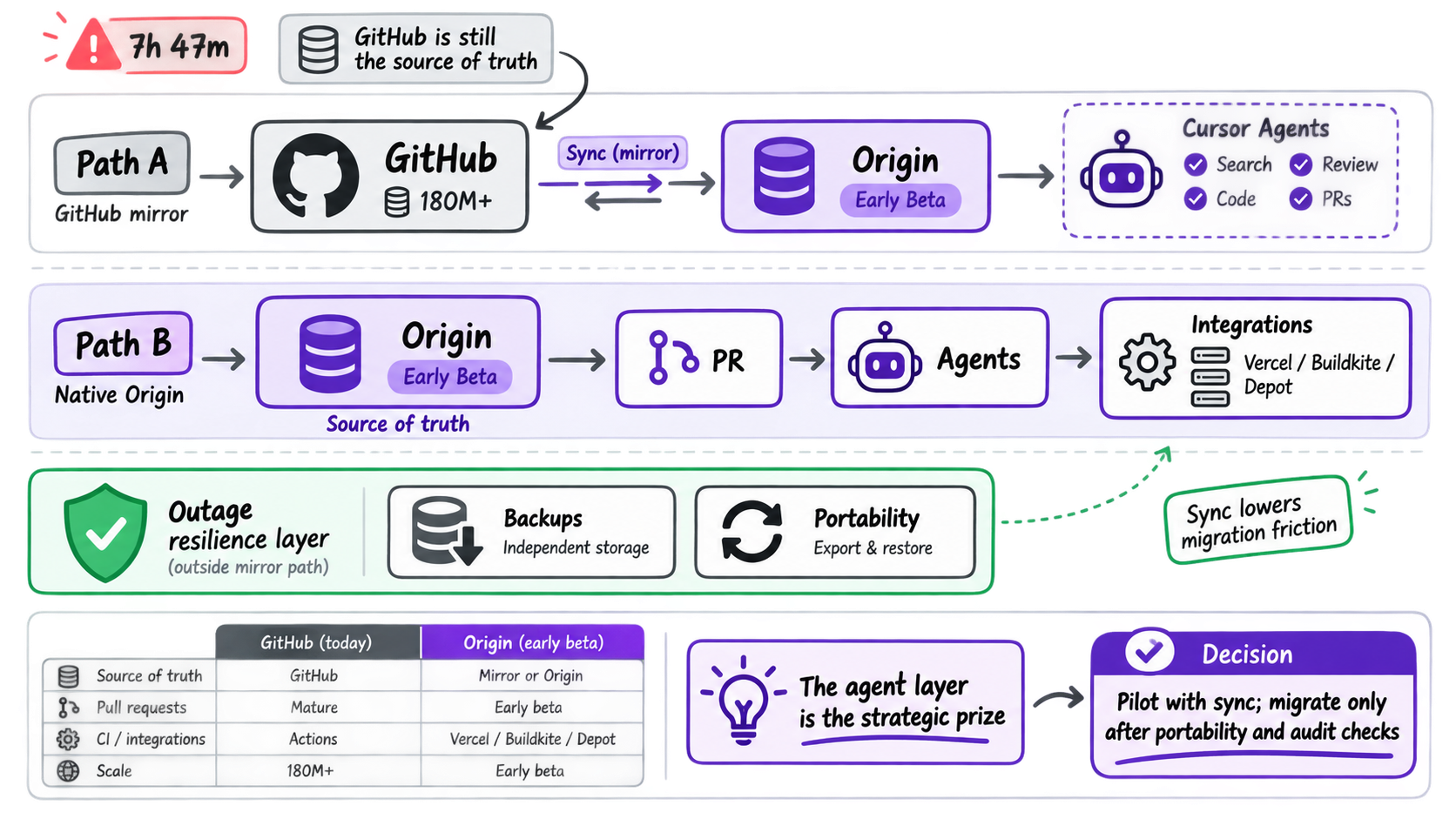
Origin starts as an adoption path, not a GitHub replacement
Origin stores code and exposes repositories, commits, checks, pull requests, app installations, and webhooks through a REST API. Cursor Automations and Cloud Agents can clone a repository, create a branch, commit, push, and open a pull request.3
Teams can enter through two paths.
- GitHub mirror: Origin synchronizes Git history, branches, tags, code, and pull requests. GitHub remains the source of truth, and pushes through the Origin remote flow to GitHub.
- Native Origin: A team creates a repository on Origin or detaches a mirror. Origin becomes the source of truth, and pull requests remain there.
The first path is the strategic wedge. As an editorial inference from the documented mirror design, a company can test Origin search, review, and agent workflows without abandoning GitHub, before making a full migration decision.4
The acquisition extends Cursor from code generation into the development platform
Cursor—not Elon Musk—made the official Origin announcement.1 Cursor separately confirmed that SpaceX had acquired the company and said SpaceX compute would support stronger, more economical models, but it did not describe Origin as Musk's personal project.5
Cursor's strategic aim goes beyond storing code: it is combining repositories, pull requests, and agent execution. Once an AI coding vendor controls the forge, it can design events, permissions, checks, and review surfaces around its agents instead of adapting every workflow to an external platform.
This direction also predates the completed SpaceX acquisition. Cursor had announced an agreement to acquire code-review company Graphite and argued that faster code generation was moving the bottleneck toward review, safe merges, and collaboration.6 Reading Origin, Graphite, Cursor Agents, and SpaceX compute as one vertical-integration strategy is an editorial inference, not a disclosed SpaceX roadmap.
The GitHub incident quantified concentration risk
The launch-day GitHub incident lasted 7 hours and 47 minutes and affected Issues, pull requests, APIs, Actions, Copilot, and identity functions. At peak, GitHub reported error rates of about 20% for web/API traffic and about 50% for archive and raw-content downloads.2
One incident does not erase GitHub's quality or ecosystem. It does show what happens when repository hosting, review, CI/CD, AI assistance, and enterprise identity share a platform: one operational failure can interrupt several stages of delivery at once.
GitHub reports more than 180 million developers. As an editorial inference from that scale, its open-source network and enterprise workflows likely carry substantial switching costs.7 GitHub has also acknowledged the load created by agentic development and says it is isolating Git and Actions, removing single points of failure, and reducing blast radius.8 Origin does not prove that GitHub is declining; it shows that a competitor now sees economic value in offering an alternative to that concentration.
Synchronization lowers migration friction but does not provide full resilience
A GitHub mirror may leave an Origin copy available for browsing and pulling during some GitHub disruptions. But GitHub Issues, Actions workflows, and secrets are not mirrored, while pushes still pass through to GitHub. When GitHub remains the source of truth, pull-request synchronization and CI can still depend on its availability.4
Detaching into a native Origin repository removes some of that dependency. It also replaces a mature concentration point with an early-beta one, so teams must validate availability, exports, auditability, permissions, secrets, and incident communication.
Calling an Origin mirror “GitHub disaster recovery” would therefore overstate the current design. It is better understood as a pre-migration path for attaching Cursor agents to an existing repository.
Social enthusiasm and distrust point to different adoption risks
Launch-day X posts joked about Origin's timing while GitHub was unavailable and welcomed additional competition. Cursor invited users to start by synchronizing GitHub repositories, while Vercel announced preview and production deployments for Origin repositories.9 The reaction volume does not establish adoption, but it shows that the incident and the product launch converged in the same public discussion.
Skepticism was not limited to missing features. Public comments raised paid-only access, CI maturity, and reluctance to entrust private code to a Musk-owned company.910 Those reactions reveal a trust and procurement cost; they are not technical evidence that Origin is insecure.
The CI criticism also needs precision. Origin documents integrations with Vercel, Depot, and Buildkite. Mirrored repositories keep CI on GitHub, while Depot and Buildkite are documented for native Origin repositories.3
Early beta does not yet support a reliability or governance comparison
Origin's documentation says its permissions and rules/protections interfaces are still changing, while additional agent-native features remain forthcoming. The public material does not establish a long-running availability record, recovery history, settled audit controls, or GitHub-scale community governance.13
This article does not include a hands-on Origin test. Documentation alone cannot prove synchronization latency, bidirectional PR consistency, agent permissions, repository export, or read/write behavior during an outage. Confidence is medium because the direction is documented, but Origin lacks a public operating history and settled enterprise controls. General availability and independent operating evidence could change the assessment.
Portability should come before adding a second hosted forge
Preparing for a GitHub outage starts with repository backups and portable CI/CD, not a migration announcement. Adding another SaaS surface may leave identity, secrets, artifacts, and deployment in the original failure boundary.
- The platform team should maintain repository mirrors in independent storage and test restoration.
- The CI owner should inventory runners, containers, artifacts, OIDC, and secrets, then separate them into reproducible units.
- The security team should review Cursor GitHub App scopes, code storage, admin access, audit logs, and contract terms before allowing a mirror.
- The pilot team should use a non-critical repository to measure sync lag, PR consistency, agent permissions, export, and restore behavior.
Origin will not end GitHub's dominance soon. Its ability to start beside GitHub still marks Cursor's move from the editor market into the development-platform market. Cursor says access to SpaceX compute can strengthen its models. Reading that resource together with a broader Cursor workflow that includes Origin is this article's conclusion and remains an editorial inference.5
Related Articles
- What GitHub's internal repository breach teaches about development controls
- Cloudflare OS as an enterprise agent workspace
- Choosing Claude Code or Codex by work structure
Sources
Cursor, “Origin Code Hosting”, August 17, 2026. It documents early-beta access, paid plans, GitHub sync, pull requests, and launch integrations. ↩↩↩
GitHub Status incidents API, incident
zkxwbgr0cnmx. It records duration, affected services, and peak error rates. ↩↩Cursor Origin docs, Pull requests, Integrations, and Origin API. ↩↩↩
Cursor Docs, “Mirror a GitHub repository”. It distinguishes synchronized and excluded data, GitHub's source-of-truth role, and detachment. ↩↩
Cursor, “Cursor is now a part of SpaceX”, August 14, 2026. ↩↩
Cursor, “Graphite is joining Cursor”, December 19, 2025. ↩
GitHub Octoverse 2025 and About GitHub. These are GitHub-reported metrics, not independent market-share estimates. ↩
GitHub, “An update on GitHub availability”, April 28, 2026. ↩
Cursor's launch post, Guillermo Rauch, Gergely Orosz, and Vercel Developers. Text was cross-checked against Techmeme's launch-day archive. ↩↩
Discussions on r/github and r/tech_x. Ownership and trust reactions are social observations, not security findings. ↩