Can Seedance 2.5 Really Deliver 4K and 180 Seconds? Reading the Official Spec Gaps
Decision before production
| Production requirement | Current treatment |
|---|---|
| Test a longer continuous action with many assets | Start a Seedance 2.5 evaluation |
| Guarantee 4K delivery | Confirm the output limit on the exact access surface |
| Produce 180 seconds in one workflow | Keep it in beta evaluation |
As of August 9, 2026, official pages simultaneously describe Seedance 2.5 with “4K” and “180 seconds” while another official page caps resolution at 720p and standard generation at 30 seconds.32Seedance 2.5 centers on a single narrative of up to 30 seconds, reference control, and localized editing. A production decision therefore has to name the access surface—Dreamina, a BytePlus resource plan, or an API—not merely the model.
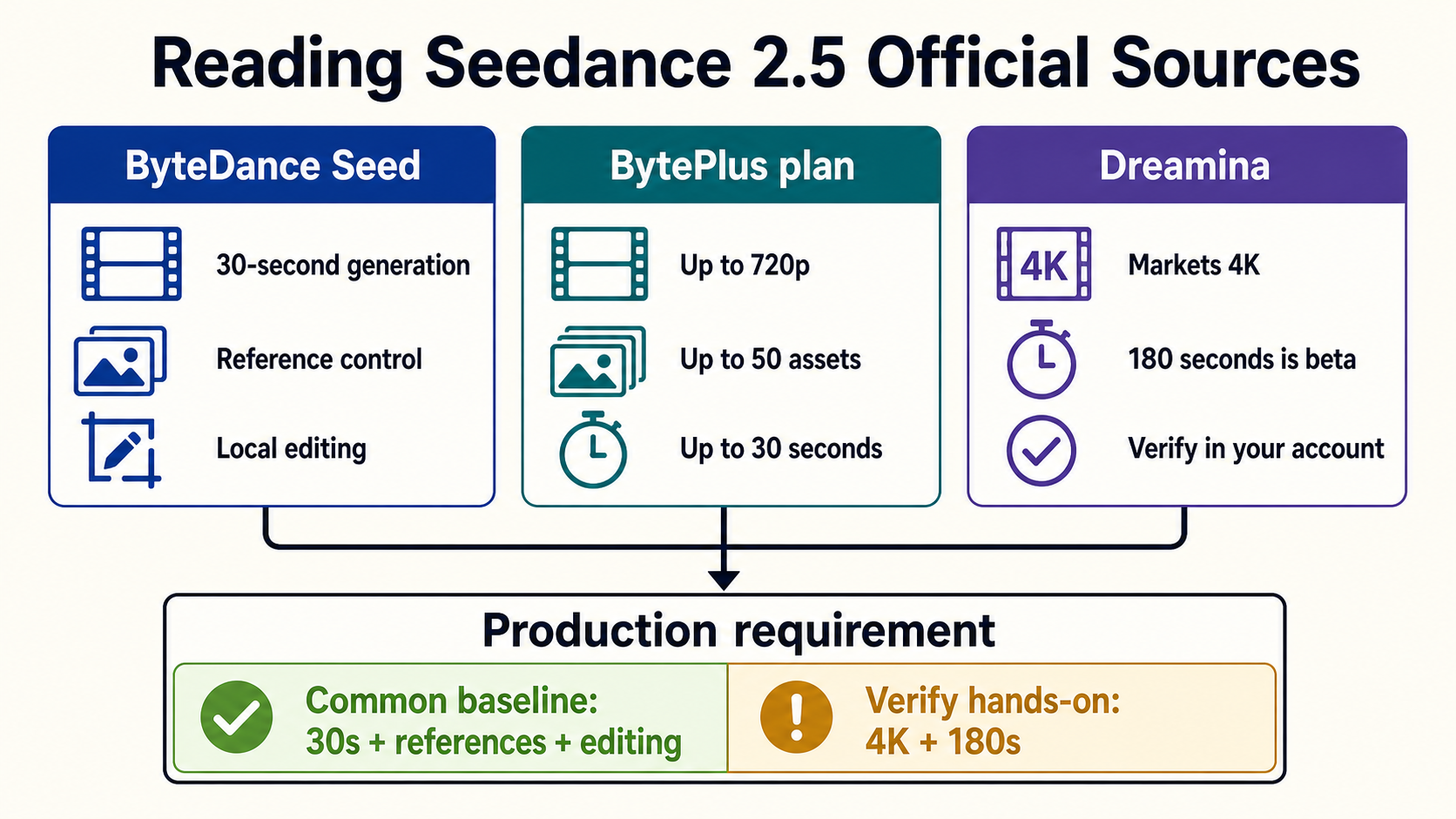
The three official pages do not publish one shared ceiling
The ByteDance Seed model page describes Seedance 2.5 as a joint audio-video generation model centered on longer narratives, stronger video-reference understanding, editing, white-model control, and green-screen editing.1 The actual output limits differ by access surface, as the official statements below show.
| Official surface | What it states | How to use it |
|---|---|---|
| ByteDance Seed | 30-second single generation, two extensions, stronger references and editing | Common model direction |
| BytePlus plan | Up to 50 assets, 480p or 720p, and up to 30 seconds | Current plan entitlement |
| Dreamina | 4K and a 180-second beta long-video mode | Verify in the account and interface |
This does not prove one page wrong; the consumer interface, cloud plan, and model page may describe different regions, subscriptions, or rollout stages.
Thirty seconds is common to the model and current plans
Duration is the most consistent capability across the official surfaces. ByteDance Seed states a single-generation limit of 30 seconds, and the BytePlus plans list generation up to 30 seconds.12
A production team still cannot combine every maximum into one requirement that says “30 seconds, 4K, and 180 seconds are all available.” The public pages do not establish that combination under one contract and one generation interface.
That window can fit a short advertisement, a product explanation, or a continuous performance into one generation unit. It does not guarantee that characters and objects remain stable to the final frame. The official pages claim better consistency, but they do not publish an independent controlled comparison.
A production test should therefore track whether the same face, object location, dialogue, and action timing survive through the ending. A useful test scene makes a character turn midway and carry an exchanged object into the final shot.
Fifty assets make role assignment the real test
BytePlus says one instruction can include up to 50 reference assets across images, video, and audio.2 ByteDance Seed also emphasizes understanding the intent, framing, and cinematic language of reference video.1
More inputs do not automatically create a more controlled result. When references conflict, the model must decide whether the character, wardrobe, movement, audio, or framing takes priority.
Split the evaluation by reference role.
- The director assigns a purpose to each character, product, camera, and audio reference.
- The generation operator removes selected references and records the output difference.
- The editor scores intended adherence separately from accidental visual similarity.
This procedure keeps “supports many inputs” separate from “obeys the intended reference.”
Local editing determines the regeneration cost
Seedance 2.5 makes localized in-video editing a headline capability.2 Dreamina says a selected region can change while lighting, composition, motion, audio, and timeline continuity remain intact.3
If that behavior is repeatable, a team could correct a label or background without regenerating an entire clip. That is an expectation derived from the vendor description, not a result SmartScope has reproduced.
Apply several small edits to the same output and record both the requested correction and damage outside the target region. The value of local editing depends less on the corrected area than on how reliably untouched areas remain unchanged.
4K is not a common Seedance 2.5 ceiling
The Dreamina product page prominently markets 4K output.3 The current BytePlus Seedance 2.5 resource plans, however, explicitly top out at 720p.2The maximum resolution that current BytePlus plans support as a procurement requirement is 720p.
BytePlus API documentation also supports 4K output for Seedance 2.0.4 A newer model version does not automatically raise every limit on every access surface.
When 4K delivery is mandatory, specify a selectable 4K option in the chosen interface or API, the output codec, watermark policy, and acceptable regeneration cost. If that option is absent, evaluate Seedance 2.0 or treat upscaling from a 720p generation as a separate production step.
The 180-second claim belongs in beta evaluation
Dreamina describes 180 seconds through a beta long-video mode.3 The ByteDance Seed page instead specifies single-generation duration and extension count, while the BytePlus plan page publishes only the standard limit.12Keep Dreamina's 180-second mode in beta evaluation until it passes a hands-on test.
A long output must preserve character identity, scene causality, audio synchronization, and editing consistency together. Production planning depends on the acceptance rate across repeated runs, not on one example reaching the maximum duration.
Public pages cannot establish quality or entitlement by themselves
This analysis compares public official pages. It does not test generation behind login, billing, queue time, regional restrictions, watermarks, or commercial-use terms. Vendor descriptions such as “production-ready” and improved consistency are not independent benchmark results.
The pages are also changing quickly. BytePlus lists Dreamina Seedance 2.5 as updated on August 7, 2026, so a buyer should recheck the model, resolution, duration, reference formats, and price in the same account before purchase.5
Using real people or third-party video and audio as references raises a separate rights question. The official Seedance 2.0 launch notice likewise states that real-person portrait references require identity verification or prior legal authorization.6
Production decisions must be bound to an access surface
Seedance 2.5 is worth testing first on projects that need a longer continuous action, many reference assets, or local editing. Hold the interface and plan constant, then record acceptance rate, regeneration count, damage outside edited regions, and audio synchronization.
Keep mandatory 4K delivery and beta long-form work in an evaluation lane until the option appears in the real account and reproduces under the same conditions. Adoption should begin with production conditions that the selected access surface can repeat, not with a merged list of maximum claims.
Related Articles
- Google Veo 3.1 API Design and Implementation
- Sora 2 Audio Engineering Guide
- Understanding Sora 2 Copyright Issues
Sources
ByteDance Seed, Seedance 2.5, accessed August 9, 2026. It describes single-generation duration, extensions, video-reference understanding, editing, white-model control, and green-screen editing. ↩↩↩↩
BytePlus, Dreamina Seedance 2.5, accessed August 9, 2026. It lists resource-plan resolution and duration, reference count, localized editing, and multilingual support. ↩↩↩↩↩↩
Dreamina, Official Seedance 2.5 AI Video Generator, accessed August 9, 2026. It markets 4K, a beta long-video mode, and localized editing. ↩↩↩↩
BytePlus ModelArk, Create a video generation task, accessed August 9, 2026. It documents input formats and resolution parameters for the Seedance 2.0 series. ↩
BytePlus, AI Models, accessed August 9, 2026. It lists Dreamina Seedance 2.5 and its update date. ↩
ByteDance Seed, Seedance 2.0 Official Launch, accessed August 9, 2026. It states the rights requirement for real-person portrait references. ↩