What Is Graph Engineering? How It Differs from Loop Engineering and Whether the "Obituary" Is True
For / Key Points
For: Engineers designing and operating AI agents who are evaluating orchestration platforms such as LangGraph.
Key Points:
- Graph Engineering is a newly prominent label from July 2026, not an established methodology
- The move from loops to graphs is containment, not generational replacement; graphs can contain loops
- Coordinating multiple loops is a valid design problem, but the main technical building blocks already existed
On July 18, 2026, one question on X was followed about four and a half hours later by an article declaring, "Loop Engineering Is Dead." The slogan was repeated the next day, allowing a replacement narrative to spread before the concept had a stable definition. This article asks whether the claim that Graph Engineering replaces Loop Engineering has a logical or technical basis.
The short answer is no. The stronger and more useful interpretation is that Graph Engineering concerns the state, permissions, and failure paths that connect multiple loops. That design problem matters, but it should be separated from the hype around the label.
From a One-Line Question to an Obituary in Four and a Half Hours
The starting point was Peter Steinberger's one-line post at 00:34 UTC on July 18, 2026: "Are we still talking loops or did we shift to graphs yet?"1 It offered neither a definition nor a set of design principles. About four and a half hours later, Hamel Husain published an X Article titled "Loop Engineering Is Dead. Enter Graph Engineering."2
The phrasing was copied quickly. Santiago Valdarrama posted, "Loop Engineering is dead. Long live Graph Engineering!" later that day in UTC, or July 19 in Japan.3 The cycle was visible enough that Rhys Sullivan had already joked that a 10,000-word article about Graph Engineering would arrive the next day.4 The community was watching content production outrun definition.
The time horizon is even shorter than it first appears. The Steinberger post that helped popularize Loop Engineering and Addy Osmani's essay were both published on June 7.56The predecessor was declared dead roughly six weeks after it was named.
As of July 20, the cited posts and public materials do not provide a standard definition, a canonical reference architecture, peer-reviewed evidence of effectiveness, or a comparative benchmark against Loop Engineering. Steinberger is better described as the catalyst for this discussion than the formal author of a method. The first step in testing the obituary is therefore to identify what Loop Engineering was designed to do.
Loop Engineering Designs the Outer Work Loop
Consider a system that starts when an issue is opened, asks an agent to implement a fix, reruns it until tests pass, and escalates to a human after three failures. That is a concrete loop. Instead of supplying every next prompt, a person defines a reusable job from trigger to termination.
A June 28 arXiv preprint calls this object a "loop specification."7 It consists of a trigger, goal, execution phase, verification, stopping rule, and external memory. The paper distinguishes it from both an ordinary programming loop and the model's internal tool-calling cycle.
Osmani similarly describes Loop Engineering as designing a system that discovers work, distributes it, checks results, records progress, and decides what comes next.6 LangChain describes a stack of agent, verification, event-driven, and hill-climbing loops.8Multiple nested loops were already part of Loop Engineering discourse before the Graph Engineering label appeared. For additional background, see the existing guides to Loop Engineering fundamentals and loop anatomy and anti-patterns.
What Is Graph Engineering? A Working Definition
There is no canonical definition yet, so this article uses a working definition inferred from the discussion and existing implementations.
Graph Engineering is the design of agents, deterministic code, tools, humans, and evaluators as nodes, together with the execution conditions, dependencies, state transitions, parallelism, retries, termination, and permissions expressed through edges and shared state.
The design surface has three parts.
| Element | What is designed | Existing example |
|---|---|---|
| Node | A processing unit such as an agent, tool, function, human, or evaluator | A LangGraph node |
| Edge | Transitions, branches, parallelism, retries, and escalation | A conditional AutoGen GraphFlow edge |
| State | Artifacts, progress, evidence, budgets, permissions, and checkpoints | LangGraph state and checkpointers |
Viewed in one diagram, Graph Engineering is the control surface that connects inputs, processing units, and review. Loop Engineering remains one of the core processes that runs inside that graph.
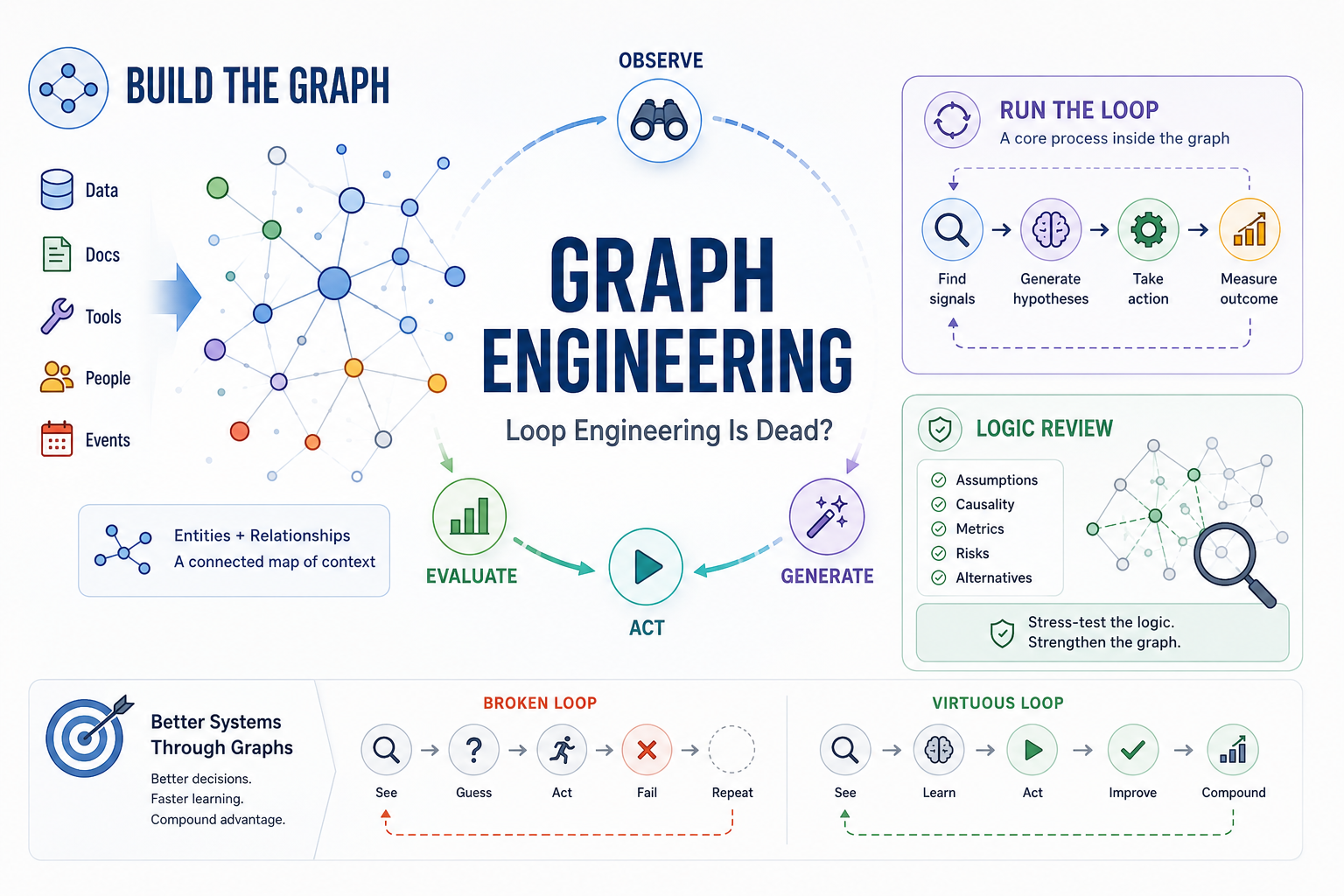
LangGraph models agent workflows with state, nodes, and edges, supporting fixed transitions, conditional branches, parallel execution, and cycles.9 AutoGen GraphFlow likewise provides directed-graph execution with sequential, parallel, conditional, and looping behavior.10 Google ADK 2.0 presents graph and dynamic workflows alongside its older deterministic sequential, parallel, and loop templates.11
The addition is not a new inner loop. It is the system-level design of how several processing units connect, share state, and terminate.
"Loops, Then Graphs" Is a Category Error
A graph can express sequences, branches, parallel fan-out, joins, and cycles. A cycle is a loop, so saying that a graph replaces a loop resembles saying that shapes replace circles.
The relationship becomes obvious in the fragment that routes a failed LangGraph test back to the writing node.
def route(state: State) -> str:
    if state["passed"]:
        return "done"
    return "human" if state["retries"] >= 3 else "retry"

g.add_conditional_edges("test", route, {
    "retry": "write", "human": END, "done": END,
})
The "retry": "write" mapping is a backward edge and therefore a loop. Adopting a graph does not remove correction, verification, or recovery loops. For Graph Engineering to be useful, it must mean designing the topology, contracts, and state transitions between loops, not discarding loops.
The linear story "Prompt → Context → Harness → Loop → Graph" is misleading for the same reason. Prompts remain inside nodes, context remains in state and memory, and loops remain as cyclic paths. Each later practice broadens the design scope rather than retiring the earlier work.
The Label Is New; the Components Are Not
The strongest case for Graph Engineering is a shift in design emphasis, not a technical invention. It moves attention from the autonomy of one loop to ownership boundaries, parallel work and joins, verification gates, permissions, and state handoffs.
The composition patterns themselves predate the label. Anthropic documented prompt chaining, routing, parallelization, orchestrator-worker, and evaluator-optimizer patterns in 2024, while recommending that complexity be added only when needed.12 LangGraph, AutoGen, and Google ADK implemented graph or composite workflows before the term became a trend.91011
The research record also contains clear predecessors. An April 2026 position paper models the Agent Loop as a single-ready-unit scheduler and proposes an explicit DAG-based Structured Graph Harness.13 The author explicitly limits the contribution to a theoretical design and protocol, not an implementation or empirical result. A January 2026 survey had already described graph-based orchestration with explicit state transitions and guardrails as "flow engineering."14
What is new is the center of gravity: naming the control plane across multiple loops as one design object. Without that distinction, relabeling existing workflow technology can be mistaken for a technical generation change.
Claim-by-Claim Verdict
The verdicts below are limited to the evidence available on July 20, 2026.
| Claim | Verdict | Evidence |
|---|---|---|
| The Graph Engineering label became prominent in July 2026 | Confirmed | The originating post and repetitions are observable123 |
| Steinberger published a detailed methodology | False | The origin was a one-line question1 |
| Graph Engineering makes Loop Engineering unnecessary | Unsupported | Existing graph systems contain loops910 |
| Graph execution for agents is a new technology | False | Implementations and earlier research already exist9101213 |
| The label is useful for coordination across multiple loops | Reasonable interpretation | It separates node, edge, and state concerns |
| Turning a workflow into a graph necessarily improves reliability | Insufficient evidence | No comparative benchmark was found |
Only one favorable judgment survives cleanly: the term can usefully name the coordination problem across multiple loops. That semantic usefulness is not evidence of implementation superiority.
Put Bounded Loops Inside a Stable Graph
The practical starting point is a stable control graph, bounded agent loops inside selected nodes, and explicit verification gates. Rather than generating a large dynamic graph from the beginning, place limited loops inside a deterministic skeleton and assign each one a clear scope and budget.
Three areas require deliberate design.
- State: Typed schemas, checkpoints and replay, and schema migration
- Control: Stopping conditions, retry, token, and time budgets, plus idempotency
- Governance: Least privilege for nodes and tools, human approval, and execution evidence
LangGraph checkpointers save state at graph steps and support interruption, resumption, human-in-the-loop review, history inspection, and recovery.15 However, nodes after a replay point execute again, so external APIs and side effects need duplicate-execution protection. Having checkpoints is not the same as having safe replay.
The main failure mode is treating graph complexity as progress.
| Risk | Typical failure |
|---|---|
| Structural growth | Nodes and edges expand until change impact becomes unclear |
| Unstable routing | An LLM-based edge chooses the wrong path |
| Execution control | Infinite retries, agent races, or duplicated side effects occur |
| State compatibility | A schema change prevents an interrupted run from resuming |
| Operational cost | More paths increase testing, latency, and token consumption |
Anthropic similarly warns that agentic systems trade cost and latency for task performance and can compound errors, so complexity should follow demonstrated need.12 A graph does not create reliability automatically. It makes failure paths explicit enough to inspect and test.
Summary: Expanded Scope, Not an Obituary
"Loop Engineering Is Dead" does not hold logically. Graph Engineering is currently a new label for designing AI agents as stateful composite workflows, not a new technology or an established method. The accurate relationship is containment: a graph connects and governs multiple loops.
The label may still last because it expands attention beyond single-agent autonomy to dependencies, permissions, state migration, and responsibility at failure boundaries. Its real test will not be engagement on X. It will be whether implementations and reproducible benchmarks compare loops and graphs on success rate, termination, cost, and recoverability.
Related Articles
Peter Steinberger's X post at 00:34 UTC on July 18, 2026 ↩↩↩
Hamel Husain, "Loop Engineering Is Dead. Enter Graph Engineering" ↩↩
Sandeco Macedo, "Stop Hand-Holding Your Coding Agent: Engineering the Loops that Replace Step-by-Step Prompting" ↩
Microsoft AutoGen documentation, "GraphFlow (Workflows)" ↩↩↩↩
Google Agent Development Kit documentation, "Template agent workflows" ↩↩
Hu Wei, "From Agent Loops to Structured Graphs: A Scheduler-Theoretic Framework for LLM Agent Execution" ↩↩
Arunkumar V et al., "Agentic Artificial Intelligence (AI): Architectures, Taxonomies, and Evaluation of Large Language Model Agents" ↩